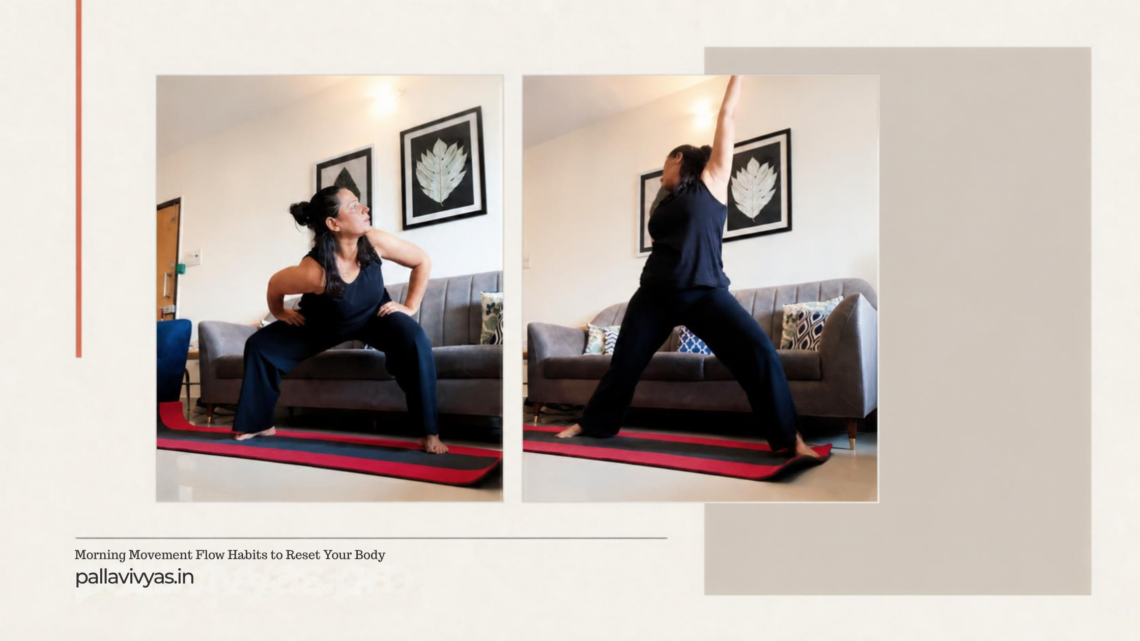
Your body isn’t lazy in the morning—it’s simply waking up.
Before reaching for your phone, tea, or coffee, try a few minutes of gentle movement, deep breathing, sunlight, and mindful activity. A simple morning movement flow can reduce stiffness, calm your nervous system, and help you start the day feeling more energized and present.
Sometimes the best way to wake up isn’t stimulation—it’s movement.
Most people believe they feel sluggish in the morning because they lack motivation. For years, I thought the same. If I woke up tired, stiff, or unenthusiastic, I assumed I needed more discipline, more caffeine, or a stronger reason to get moving.
What I have learned instead is surprisingly simple:
Your body is not lazy in the morning. It is simply stiff.
After several hours of sleep, your joints, muscles, connective tissues, and nervous system are transitioning from a state of rest into a state of movement. That heaviness you feel when you first wake up is often not a lack of energy—it is your body asking for gentle movement.
This realization completely changed my mornings.
Instead of reaching for my phone or heading straight to the kitchen for tea or coffee, I started practicing a simple morning movement flow. Nothing complicated. No workout clothes. No fitness tracker. No pressure to perform.
Just a sequence of movements that helps me wake up naturally.
The result has been profound. My mornings feel calmer, my body feels more mobile, and I start the day with greater clarity and focus.
Why Morning Stiffness Happens
During sleep, the body remains relatively still for several hours. Blood circulation slows compared to active daytime levels, joints spend long periods in fixed positions, and muscles remain inactive.
This is completely normal.
The stiffness many people experience in the morning is often the body’s way of saying:
“Let’s move before we do anything else.”
Gentle mobility exercises can increase circulation, lubricate joints, improve flexibility, and signal the nervous system that it is safe to transition into an active state.
Rather than shocking the body awake, movement creates a smoother and more natural awakening process.
Step 1: Begin Before Leaving Your Bed
One of the easiest ways to build a sustainable habit is to remove friction.
Before your feet even touch the floor, spend a few minutes moving.
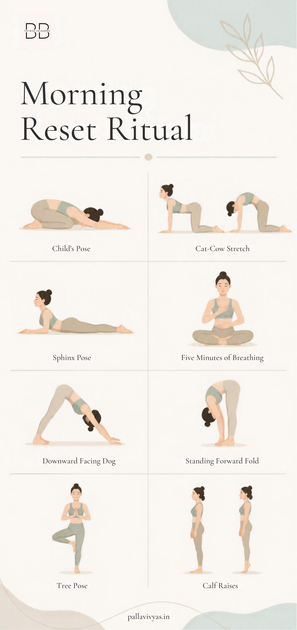
Child’s Pose
A gentle stretch that lengthens the back, relaxes the hips, and encourages deep breathing.
It creates an immediate sense of grounding and helps release tension accumulated during sleep.
Cat-Cow Stretch
Slowly alternate between arching and rounding your spine.
This movement improves spinal mobility and gently wakes up the entire back and core.
Sphinx Pose
The sphinx pose opens the chest and encourages extension through the spine.
For people who spend long hours sitting or looking at screens, it can be a refreshing counterbalance.
Five Minutes of Breathing
Before moving on, spend five minutes breathing deeply and intentionally.
No complicated technique is required.
Simply inhale slowly, exhale slowly, and allow your breath to guide your awareness back into your body.
This simple practice can help regulate your nervous system and create a calmer foundation for the day ahead.
Step 2: Move Once You Get Out of Bed
When you step onto the floor, continue the flow with a few standing movements.
Downward Facing Dog
This classic yoga posture stretches the calves, hamstrings, shoulders, and spine simultaneously.
It also encourages circulation throughout the body and helps relieve residual stiffness.
Standing Forward Fold
Allow your upper body to hang naturally.
There is no need to touch your toes.
The purpose is simply to create space in the back body and allow gravity to assist the stretch.
Tree Pose or Calf Raises
Balance-based movements wake up the stabilizing muscles that help support posture throughout the day.
Tree pose encourages focus and coordination, while calf raises improve circulation and strengthen the lower legs.
Choose whichever feels right for your body.
Step 3: Invite Nature Into Your Morning
Once your body has started moving, open your windows.
Fresh air and natural light provide powerful signals to your body’s internal clock.
Take a few moments to stand by the window.
Stretch your arms overhead.
Roll your shoulders.
Move your neck gently through comfortable ranges of motion.
If sunlight is available, spend a few minutes facing the morning light.
This simple exposure can help regulate circadian rhythms and support healthy sleep-wake cycles.
Sometimes the most effective wellness practices are also the simplest.
Step 4: Turn Everyday Tasks Into Movement Opportunities
One of the biggest misconceptions about health is that movement only counts when it happens inside a gym.
In reality, some of the healthiest people in the world move frequently throughout the day rather than relying solely on structured exercise.
This is why I love incorporating movement into ordinary morning tasks.
Water Your Plants
Instead of rushing through the process, make it mindful.
Walk around your space multiple times.
Squat occasionally.
Reach overhead.
Move naturally.
A few rounds of watering plants can become an effortless mobility practice.
Make Your Bed
Making your bed is not only a productivity habit—it is also movement.
Bending, stretching, reaching, and organizing your environment creates gentle activity while giving you an immediate sense of accomplishment.
Put Your Room in Order
Tidying your room creates both physical and mental clarity.
As you move around, use opportunities to stretch.
Hold a window bar or sturdy surface and lengthen your arms.
Stretch your legs.
Practice balance.
Turn routine actions into moments of mindful movement.
The Goal Is Flow, Not Fitness
What makes this morning movement flow so effective is that it does not feel like exercise.
There is no pressure to burn calories.
No pressure to break records.
No pressure to be flexible.
The goal is simply to reconnect with your body.
Some mornings you may spend fifteen minutes moving.
Other mornings you may spend thirty.
The exact duration matters less than the consistency.
When movement becomes part of your morning rhythm rather than another task on your to-do list, it becomes sustainable.
A Different Way to Start the Day
Many of us begin our mornings by immediately consuming something—notifications, news, emails, tea, coffee, or social media.
But before consuming anything, consider creating space to connect with yourself.
Move.
Breathe.
Stretch.
Open the windows.
Feel the sunlight.
Water the plants.
Make the bed.
Allow your body to wake up naturally.
Because your body is not lazy in the morning.
It is simply asking for movement.
And sometimes, a few mindful minutes of movement are enough to transform the entire day.
You may like to read: 5 Things to Do Every Morning to Transform Your Day and Boost Productivity