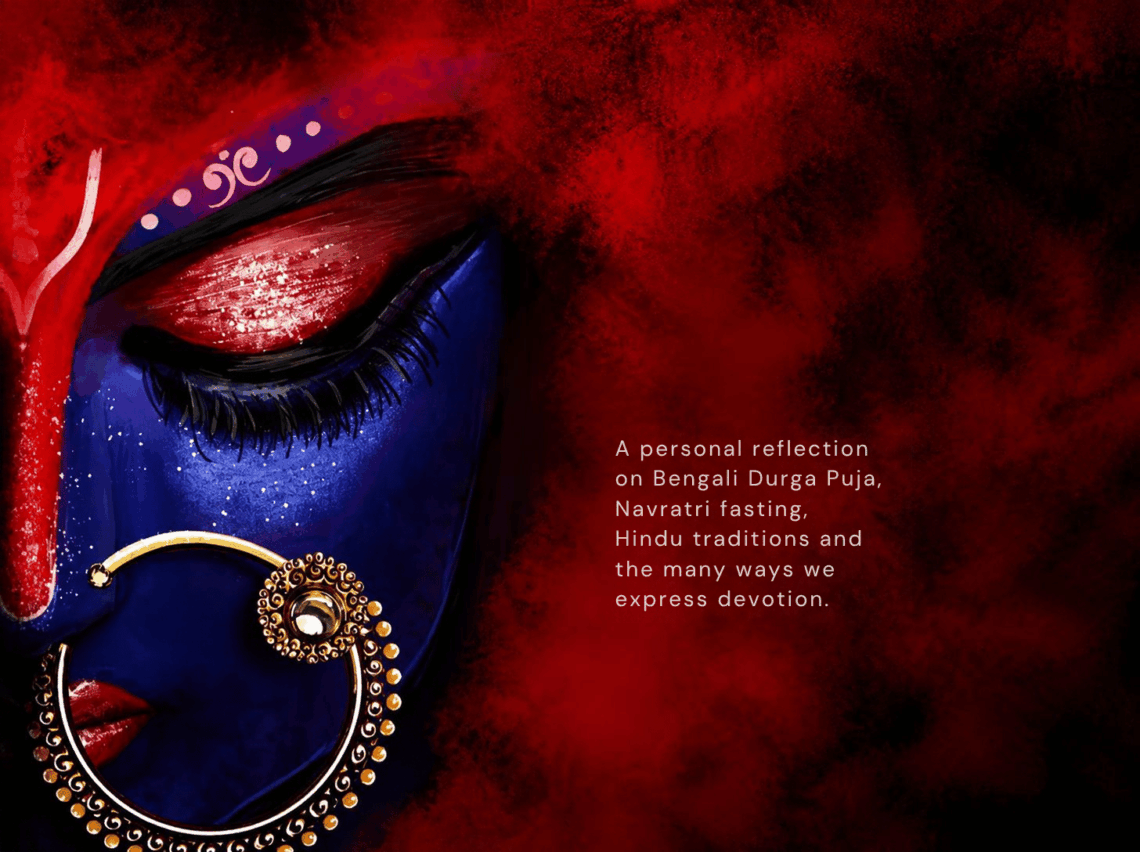
Same Maa Durga, different traditions — why do many Bengali families eat non-vegetarian food during Durga Puja while many of us give it up during Navratri? Exploring the cultural, religious and historical roots of these practices made me reflect on how the same faith can be expressed in such different ways across India.
Every Navratri, I have grown up seeing people around me give up non-vegetarian food, follow vrat, eat sattvic meals and become a little more mindful of what goes on their plates.
And then there is Bengal.
During Durga Puja, fish and meat are part of the festive celebrations for many Bengali families. The same Maa Durga, the same devotion, the same prayers… yet such different food practices.
It made me wonder: If we are worshipping the same Goddess, why do our ideas of devotion look so different?
The more I read about it, the more I realised that Hinduism has never been one uniform set of practices followed identically across the country. Our faith has been shaped by regional histories, local traditions, different schools of worship and the way generations have understood their relationship with the divine.
In Bengal, Durga Puja is deeply rooted in the Shakta tradition, which worships the Goddess as the supreme divine power. Some historical Shakta traditions included animal sacrifice, while Bengali food culture, with its deep relationship with fish, also became part of the wider festive landscape. For many families, Durga’s arrival is like a daughter returning to her parents’ home. It is a time for reunion, hospitality, elaborate meals and celebration.
Of course, not every Bengali household eats non-vegetarian food during Puja. Vegetarian bhog is an important part of many celebrations, too. And eating meat at a festive meal is not the same as offering it to the Goddess in a ritual.
In many other parts of India, Navratri is observed through fasting, vegetarian food and the idea of sattva — cultivating purity, restraint and calmness through our choices. Avoiding certain foods becomes a way of disciplining the body and mind and expressing devotion.
Both practices have their own histories and meanings.
And perhaps this is what I find most fascinating about Hinduism. The same divine feminine can be worshipped as the fierce warrior who destroys evil, the nurturing mother who protects her children, and the daughter whose homecoming fills a household with joy. Our rituals may differ because our cultures have found different ways to express that relationship.
Some of us express devotion by fasting. Some through elaborate offerings. Some through prayer, some through celebration, and some through the quiet discipline of our everyday lives.
Perhaps the mistake is in assuming that because our rituals look different, someone’s faith must be less sincere.
Food, after all, is not merely food in our culture. It carries memory, identity, geography, family traditions and sometimes generations of religious understanding. What one family considers an essential part of a festival, another may lovingly give up as an act of devotion.
Neither practice needs to become a competition.
I think it is worth remembering that understanding a tradition is different from having to follow it. We can remain deeply rooted in our own customs while being curious about someone else’s.
Because perhaps faith is not always about everyone doing the same thing. Perhaps it is also about understanding why we do what we do — and allowing others the space to find meaning in their own way.
Same Maa Durga. Different traditions. And so many ways to express the same love and reverence.
This was my self-reflection on Maa Durga. But if you are interested to understand in much depth then click this detailed post on Why Do Bengalis Eat Non-Veg During Durga Puja While We Give It Up During Navratri, When We Worship the Same Maa Durga?
Related: Why is Kolkata’s Durga Puja recognised as a UNESCO intangible cultural heritage?