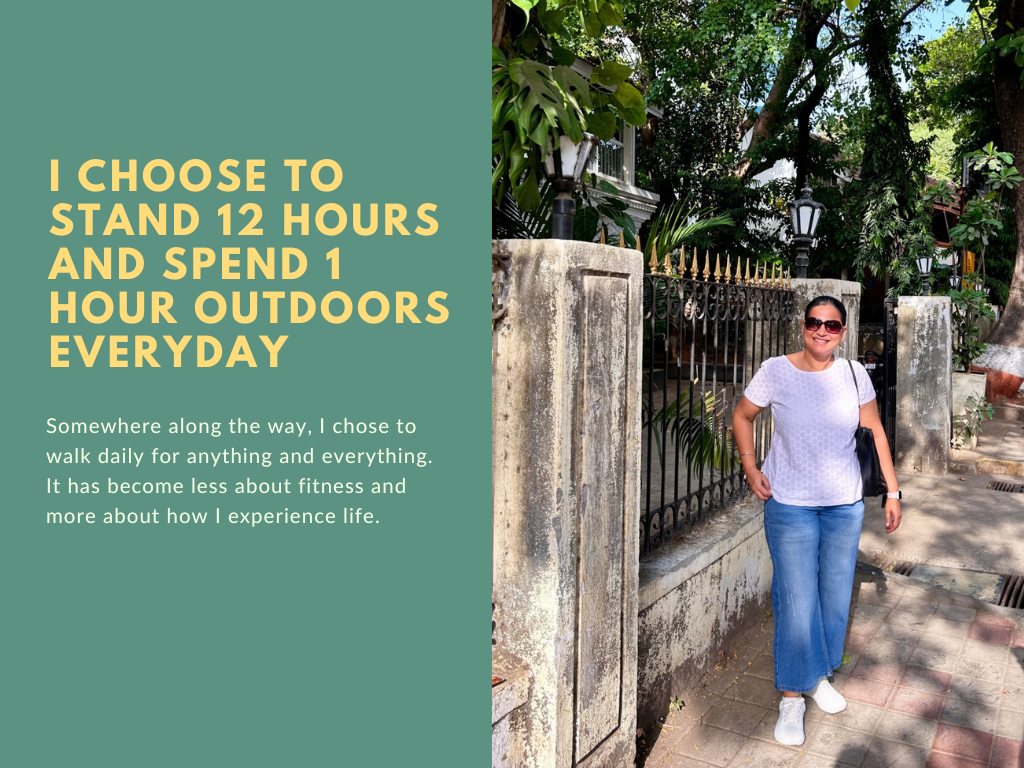
My journey with 12 hours standing and 1 hour outdoors daily started as a simple health challenge, but it ended up teaching me far more about energy, movement, and living intentionally in a busy city.
In modern city life, we spend an astonishing amount of time sitting.
We sit while working. We sit while commuting. We sit while scrolling through our phones. Even our leisure activities often involve another chair, another screen, and another indoor space.
A few months ago, I decided to experiment with two simple daily commitments:
- Stand for at least 12 hours every day.
- Spend at least 1 hour outdoors every day.
At first, these goals seemed almost too simple to make a difference. They weren’t intense fitness challenges. They didn’t require a gym membership or expensive equipment.
But over time, these two habits quietly transformed the way I felt, moved, and experienced my days.
The Realization: Movement Isn’t Just Exercise
Like many people, I used to think fitness happened during workouts.
If I completed my yoga session, aerobics class, treadmill walk, or strength training, I considered myself active.
But there was a blind spot.
I could exercise for one hour and still spend most of the remaining day sitting.
Research increasingly shows that prolonged sedentary behavior can negatively impact both physical and mental health, and that regularly breaking up sitting time with movement provides measurable benefits.
That realization changed my perspective.
The goal wasn’t simply exercising more.
The goal was living less sedentarily.
What Standing for 12 Hours Taught Me
When I first set a standing goal on my Apple Watch, I viewed it as another metric to complete.
Soon I began noticing subtle changes.
I naturally walked more between tasks.
I stretched more often.
I avoided long, uninterrupted sitting sessions.
I became more conscious of my posture and body alignment.
Instead of treating movement as a scheduled event, movement became woven into my day.
The surprising lesson was that health is often built through small actions repeated consistently rather than dramatic efforts performed occasionally.
The Unexpected Power of One Hour Outdoors
The second commitment seemed even simpler.
One hour outdoors.
Not necessarily exercising.
Not necessarily running.
Just being outside.
As someone living in Mumbai, this wasn’t always easy.
Some days were humid.
Some days were crowded.
Some days I wanted to stay indoors.
Yet whenever I stepped outside, something shifted.
The mind felt less cluttered.
The body felt more awake.
My breathing felt deeper.
I felt more connected to the rhythm of the day rather than the rhythm of notifications.
Scientific studies suggest that exposure to natural environments and green spaces can improve mood, reduce anxiety, lower stress, and support cognitive function.
What fascinated me was that these benefits were not abstract concepts.
I could feel them.
The Outdoor Discovery I Didn’t Expect
One of the most interesting discoveries came while tracking my fitness metrics.
On days when I spent longer periods walking outdoors, especially in areas with trees, open skies, and natural surroundings, I often felt more energized compared to similar indoor cardio sessions.
Research comparing urban and natural walking environments has found that walking in natural settings can improve positive mood and reduce anxiety more effectively than walking in purely built environments.
Perhaps this explains why a walk under trees often feels different from a walk staring at a screen.
The body moves.
But the mind also recovers.
Better Energy Without Chasing Productivity
One thing I didn’t anticipate was how these habits affected my energy.
Not in a dramatic “life-changing overnight” way.
But in a steady, sustainable way.
I felt less sluggish during the day.
I found it easier to maintain momentum.
I experienced fewer afternoon energy crashes.
Morning sunlight exposure and regular outdoor activity are known to support circadian rhythm regulation, mood, alertness, and sleep quality.
Instead of constantly looking for energy through caffeine, I started finding it through movement and sunlight.
A Lesson for Urban Living
Many wellness conversations focus on adding more.
More workouts.
More supplements.
More productivity hacks.
But this experiment taught me that sometimes wellness comes from returning to basics.
Stand more.
Walk more.
See the sky.
Feel the sunlight.
Watch birds fly overhead.
Take phone calls while moving.
Spend time in parks, near the sea, or simply on a quiet street lined with trees.
The beauty is that these habits are accessible.
You don’t need perfect conditions.
You only need consistency.
What I Learned About Health
Today, I no longer see my standing goal or outdoor goal as fitness metrics.
They are reminders.
Reminders that the human body was designed to move.
That the mind benefits from nature.
That health isn’t built only inside a gym.
And that sometimes the simplest habits create the most profound shifts.
In a city that constantly encourages us to rush, consume, and stay connected digitally, standing more and spending time outdoors became my way of reconnecting with something far more important:
Myself.
Perhaps wellness is not always about doing more.
Sometimes it is simply about sitting less, moving more, and remembering that the world outside still has something to teach us every day.
Related Post: Knowledge Changes Nothing Until You Reflect on It