Midlife knee health deserves more attention than we usually give it. Occasional stiffness, clicking knees or discomfort while climbing stairs may seem like normal signs of ageing, but your joints need not simply deteriorate with time. Ayurveda has long emphasised protecting joint health through movement, nourishment, warmth and balanced living, while modern research highlights the importance of muscle strength, healthy body weight, exercise and inflammation management. Here’s what Ayurveda and modern science teach us about keeping your knees strong, mobile and supported through midlife.
Midlife changes the way we need to care for our bodies.
The things we could once take for granted—walking long distances, climbing stairs, dancing for hours, sitting cross-legged—may suddenly come with stiffness, an occasional ache or that familiar cracking sound from the knees.
It is tempting to think, “This is just ageing.”
But ageing does not automatically mean that your knees have to become weak or painful.
What Ayurveda has described for centuries as a degenerative, Vata-related joint condition has interesting parallels with what modern medicine now understands about osteoarthritis: the knee is not simply a piece of cartilage that gradually “wears out.” It is a living joint involving cartilage, bone, muscles, ligaments, synovium and surrounding tissues.
And caring for your knees in midlife is much more about protecting the whole joint than searching for one miracle remedy.
The cartilage conversation we need to change
You may have heard that knee cartilage “wears away” with age.
There is some truth to this, but the picture is more complicated.
Cartilage contains specialised cells called chondrocytes that continually maintain and repair the cartilage matrix. With ageing, excessive mechanical stress, inflammation and other factors, the balance can shift towards breakdown.
So the body isn’t deliberately destroying its cartilage as a defence mechanism.
Rather, the repair-and-maintenance system can become overwhelmed.
That is why the goal in midlife should not be to wait until the cartilage is badly damaged and then look for a cure.
The smarter approach is:
Protect. Strengthen. Move. Nourish. Recover.
What Ayurveda has been saying about joints
Ayurveda describes a degenerative joint condition known as Sandhigata Vata, traditionally associated with pain, stiffness, crepitus and restricted joint movement.
The Ayurvedic approach doesn’t focus only on the painful joint. It considers the balance of Vata, tissue nourishment, digestion, strength and overall lifestyle.
Traditional approaches may include:
- Snehana or oleation
- Swedana or therapeutic warmth
- appropriate exercise and movement
- nourishing foods
- local oil applications
- strengthening and rejuvenating therapies
- and, under professional supervision, treatments such as Basti
Interestingly, some of these principles overlap with modern preventive thinking.
Warmth can help stiffness.
Movement maintains function.
Strength protects joints.
Healthy body composition reduces mechanical stress.
Adequate nutrition supports muscle and tissue maintenance.
The language is different, but the underlying message is surprisingly compatible:
Don’t wait for the joint to deteriorate before you start caring for it.
The Ayurvedic herbs worth knowing about
Ayurveda has a long history of using herbs for joint discomfort. Modern research has also started investigating some of these herbs.
1. Boswellia serrata — Shallaki
Boswellia is probably one of the most interesting Ayurvedic herbs when it comes to knee osteoarthritis.
Studies of standardised Boswellia extracts have reported improvements in pain, stiffness, mobility and physical function. Some recent research has even investigated changes in cartilage morphology.
That sounds exciting—but it is important not to overstate the evidence.
Boswellia has promising evidence for symptom management and inflammatory pathways. It has not been conclusively proven to regenerate severely damaged human knee cartilage. Read Clinical Papers
2. Curcumin — from turmeric
Curcumin, the principal bioactive compound in turmeric, has been extensively studied for its anti-inflammatory effects.
Clinical trials and reviews suggest that standardised curcumin preparations may help reduce knee osteoarthritis pain and improve function.
But there is an important distinction:
Eating turmeric as part of your diet is not the same as taking a standardised curcumin extract used in a clinical study.
Supplement quality, formulation and dosage matter.
3. Ashwagandha
Ashwagandha occupies a different place in Ayurveda.
It is traditionally considered a Rasayana—associated with nourishment, strength and resilience.
It may have a role as part of a broader wellness programme, particularly when weakness, poor recovery or general fatigue are concerns.
However, the evidence specifically showing that Ashwagandha prevents knee cartilage loss is much weaker than the evidence for Boswellia or curcumin for osteoarthritis symptoms.
Personally recommend Organic India Pure Ashwagandha Root Capsule
What about Guggulu?
Guggulu has an important place in traditional Ayurvedic joint formulations, including preparations used for Sandhivata.
But this is one area where self-prescribing is not advisable.
Some formulations can contain multiple herbs or mineral ingredients and may interact with medications or be inappropriate for certain people.
Ayurvedic does not automatically mean risk-free.
A qualified Ayurvedic physician should select the formulation rather than choosing one based simply on an online recommendation.
But here is the most important part: strength may matter more than any herb
If there is one lesson modern research makes particularly clear, it is this:
Your muscles are part of your joint-protection system.
Strong quadriceps, hamstrings, glutes and calf muscles help your body handle everyday loads more efficiently.
This is why resistance training becomes increasingly important in midlife.
You don’t have to lift enormous weights.
You need progressive, controlled and appropriate resistance.
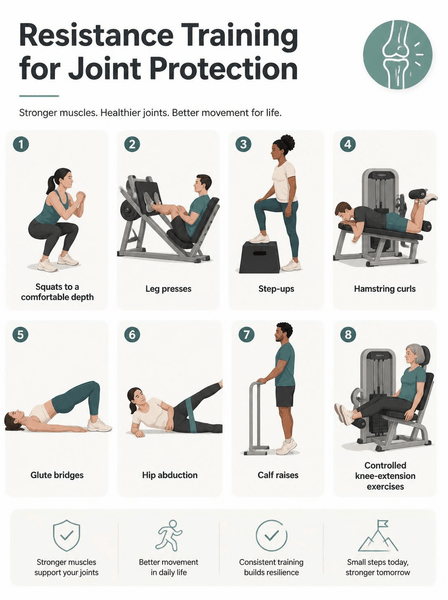
Exercises may include:
- squats to a comfortable depth
- leg presses
- step-ups
- hamstring curls
- glute bridges
- hip abduction
- calf raises
- controlled knee-extension exercises
The right exercises depend on your current strength, mobility and any existing knee condition.
And if you already enjoy activities such as walking, cycling, swimming or dancing, don’t assume that ageing automatically means giving them up.
Movement is not the enemy of your joints. Poorly managed loading can be.
Should you stop exercising because you’re worried about cartilage?
Usually, no.
This is one of the most counterproductive fears around knee health.
People sometimes think:
“My cartilage is wearing down, so I should use my knees as little as possible.”
But prolonged inactivity causes its own problems.
Muscles become weaker.
Mobility decreases.
Body weight may increase.
Balance can deteriorate.
Everyday activities can become harder.
The better approach is to find your optimal level of loading.
Think:
Load → recover → adapt.
rather than:
Load → pain → complete rest.
If an activity repeatedly causes significant swelling or pain that persists beyond the activity, however, that is a signal to modify the activity and get the knee assessed.
Your weight matters—but so does your muscle
Midlife often brings changes in body composition.
You may find that maintaining the same weight becomes harder while muscle mass gradually declines and body fat increases.
This is why the goal shouldn’t simply be:
“Lose weight.”
It should be:
“Lose excess fat while preserving muscle.”
Resistance training plus adequate protein is one of the most useful combinations for this.
For someone who is overweight and has knee osteoarthritis, even modest weight reduction can reduce the mechanical burden on the knees and improve symptoms.
But crash diets are not the answer.
Your joints need a body that is strong, nourished and active, not simply lighter.
Don’t forget protein
As we enter midlife, maintaining muscle becomes increasingly important.
Include good protein sources regularly:
- dal and legumes
- paneer
- Greek yoghurt/curd
- eggs, if you eat them
- fish and seafood
- chicken
- tofu and soy
- whey protein when convenient
Protein isn’t a knee medicine.
But preserving muscle is one of the most practical ways to support your joints.
What about oil massage?
Ayurvedic Abhyanga has traditionally been used for Vata-related conditions.
For stiff knees, a gentle warm oil massage may provide temporary comfort and help you feel less stiff.
It can be a lovely self-care ritual.
But let’s keep expectations realistic.
Massage does not mean that oil is penetrating the joint and rebuilding cartilage.
Its value is more likely to be in warmth, relaxation, local comfort and helping you maintain a regular movement routine.
And if your knee is acutely swollen, hot or injured, don’t simply apply heat and massage it—get the problem assessed.
Your midlife knee-care checklist
You don’t need a complicated routine.
Start here:
Every day
Move.
Walk, stretch, cycle, dance or practise appropriate mobility.
Eat enough protein.
Distribute protein across your meals rather than consuming most of it at one meal.
Eat colourful, minimally processed foods.
Vegetables, fruits, legumes, nuts, seeds and whole grains provide a nutrient-rich foundation.
Maintain a healthy body composition.
Sleep and recover.
2–3 times a week
Do progressive resistance training focusing on:
legs + glutes + hips + calves + core.
As needed
Use gentle warmth, mobility work or traditional oil massage for stiffness if it feels good and is appropriate for you.
And if you have persistent pain, swelling, locking, instability or difficulty walking, don’t keep treating it as “normal ageing.”
Get the knee properly evaluated.
The midlife mindset shift
Perhaps the biggest lesson is this:
Don’t wait for pain to become your motivation.
We often start caring for our knees only after climbing stairs becomes uncomfortable.
But midlife gives us an opportunity to work preventively.
You don’t need to eliminate every squat.
You don’t need to stop dancing.
You don’t need to be frightened of every crack and click.
And you don’t need to search endlessly for the one herb that will save your cartilage.
Instead, build a body that can support its joints.
Strong muscles.
Healthy weight.
Adequate protein.
Regular movement.
Good recovery.
An anti-inflammatory eating pattern.
And, where appropriate, evidence-informed Ayurvedic therapies.
That is a much more sustainable form of knee care.
One final thought
Ayurveda’s wisdom around ageing is not simply about treating disease after it appears. It is also about maintaining balance, nourishment and function before the body begins demanding your attention.
Modern science is increasingly arriving at a similar conclusion.
Your knees are not disposable parts that you simply “wear out.” They are living structures that respond to how you move, eat, train and recover.
Midlife is not the beginning of the end for your joints.
It can be the beginning of taking much better care of them.