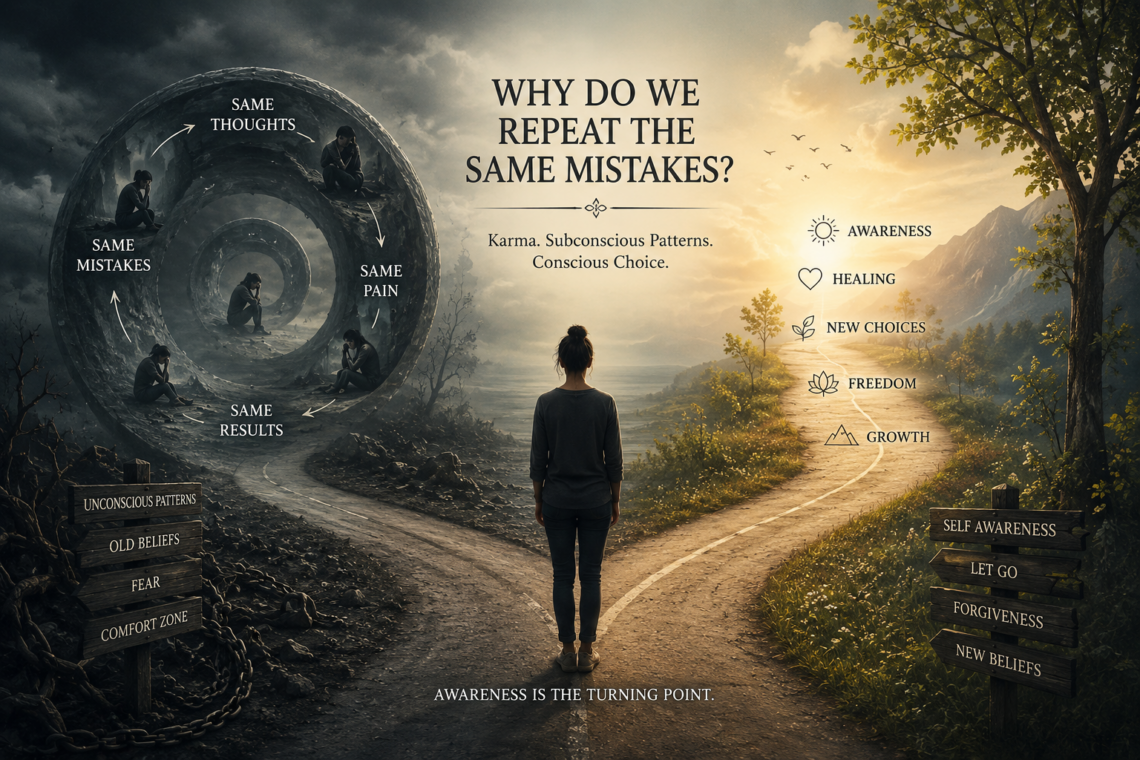
Why do we repeat the same mistakes even when we know better? The answer lies somewhere between karma, subconscious programming, and the modern world’s endless cycle of emotional triggers.
Why Do We Repeat the Same Mistakes
Have you ever found yourself standing at a familiar crossroads, wondering how you ended up here again?
The same relationship that leaves you hurt.
The same financial mistake you promised never to repeat.
The same emotional reaction that creates the same conflict.
The same self-sabotaging habit that keeps pulling you back.
What’s frustrating is that most of us are not unaware. We know what went wrong. We understand the consequences. Yet somehow, despite our best intentions, we walk the same path again.
This raises a profound question:
If experience is the greatest teacher, why do human beings keep repeating the same lessons?
The answer may lie in three interconnected forces: karma, subconscious conditioning, and the brain’s preference for familiarity over growth.
Suggested Read: Emotional Minimalism: Letting Go of Toxic Thoughts and People
The Modern Myth: Awareness Automatically Creates Change
We live in an age overflowing with information.
Thousands of self-help books.
Millions of motivational videos.
Unlimited access to psychology, spirituality, and personal development.
Yet anxiety is rising, relationships are struggling, and many people feel trapped in recurring life patterns.
Why?
Because knowledge and transformation are not the same thing.
Knowing smoking is harmful doesn’t make quitting easy.
Knowing a relationship is unhealthy doesn’t guarantee leaving.
Knowing procrastination is damaging doesn’t automatically create discipline.
Modern psychology suggests that repeated mistakes are often driven by unconscious patterns rather than conscious decisions. The mind naturally gravitates toward what feels familiar, even when that familiarity causes suffering.
The conscious mind may want change.
The subconscious mind wants safety.
And to the subconscious, familiar often feels safer than healthy.
The Subconscious Mind: Running Yesterday’s Program
Think of your subconscious mind as an operating system quietly running in the background.
Many of the beliefs, fears, emotional reactions, and behavioral patterns that guide your life were formed years ago.
Perhaps you learned that love requires sacrifice.
Perhaps you learned that speaking up creates conflict.
Perhaps you learned that success attracts criticism.
Those beliefs may no longer serve you, but the subconscious continues operating as if they are still true.
This explains why people often say:
“I knew better, but I still did it.”
Because the battle was never between knowledge and ignorance.
It was between awareness and conditioning.
The subconscious mind is not concerned with happiness. It prioritizes familiarity and predictability. Under stress, it often defaults to established emotional and behavioral patterns.
Suggested Book: Subconscious Mind Reprogramming:: A Step-by-Step Guide to Harnessing the Power of Your Subconscious Mind for Lasting Transformation
Karma: The Spiritual Perspective on Repeated Patterns
Ancient spiritual traditions observed this phenomenon long before modern psychology existed.
They called it karma.
Contrary to popular belief, karma is not simply a cosmic reward-and-punishment system.
At its deeper level, karma can be understood as the law of recurring patterns until awareness transforms them.
Life presents similar situations repeatedly because the underlying lesson remains unresolved.
You may change cities.
You may change jobs.
You may change partners.
Yet the emotional pattern remains.
The faces change.
The lesson doesn’t.
From a karmic perspective, life is not punishing you by repeating experiences.
Life is teaching you.
Imagine a student refusing to learn mathematics. The school doesn’t punish the student by repeating the exam. The exam returns because the lesson remains incomplete.
In the same way, karma often appears as recurring situations that continue until we respond differently.
Why We Are Drawn to What Hurts Us
One of the most confusing aspects of human behavior is our tendency to return to what causes pain.
Why do people repeatedly choose emotionally unavailable partners?
Why do some continue unhealthy habits despite knowing the consequences?
Why do we recreate situations that make us suffer?
Psychologists describe this as a tendency to repeat familiar emotional experiences, often unconsciously attempting to gain mastery over unresolved wounds or conflicts from the past.
The subconscious isn’t necessarily trying to hurt you.
It’s trying to solve an old problem using old methods.
The tragedy is that the solution often becomes part of the problem.
The Role of Ego in Repeating Mistakes
The ego loves certainty.
Admitting a mistake requires humility.
Changing a pattern requires uncertainty.
Growth demands stepping into the unknown.
And the ego dislikes the unknown.
This is why many people repeatedly defend beliefs, behaviors, and decisions that no longer serve them.
The mistake itself is rarely the greatest obstacle.
The attachment to being right is.
True transformation begins when we stop asking:
“Why is this happening to me?”
And start asking:
“What is this trying to teach me?”
Breaking the Cycle: From Reaction to Awareness
The good news is that patterns are not permanent.
A cycle only survives while it remains unconscious.
The moment you become deeply aware of a pattern, you create space between the trigger and the response.
That space is where freedom begins.
Breaking recurring mistakes requires:
1. Observation Without Judgment
Instead of criticizing yourself, observe the pattern.
Awareness heals faster than self-condemnation.
2. Identify the Emotional Reward
Every repeated behavior provides something.
Comfort.
Validation.
Security.
Control.
Find the reward beneath the behavior.
3. Question the Story
Ask yourself:
- Is this belief still true?
- Who taught me this?
- Would I choose this pattern consciously today?
4. Respond Differently Once
Karma weakens the moment you choose a new response.
A single conscious action can interrupt years of unconscious repetition.
The Real Purpose of Repeated Mistakes
Perhaps mistakes are not failures at all.
Perhaps they are messages.
Life keeps presenting the same lesson until we evolve beyond the version of ourselves that created the pattern.
The repeated relationship.
The recurring conflict.
The familiar disappointment.
The self-sabotaging habit.
Each may be pointing toward something deeper than the surface event.
Not punishment.
Not bad luck.
Not destiny.
But an invitation to become more conscious.
Because the purpose of life may not be to avoid mistakes entirely.
It may be to become aware enough that we stop repeating the ones that no longer belong to who we are becoming.
Final Thought
The moment you stop seeing repeated mistakes as evidence of failure and start seeing them as invitations for growth, everything changes.
The pattern loses its power.
The lesson becomes visible.
And what once felt like karma begins to look a lot like evolution.
Related: Can Karma Be Transformed Through Awareness? Understanding Karma, Consciousness and Inner Change