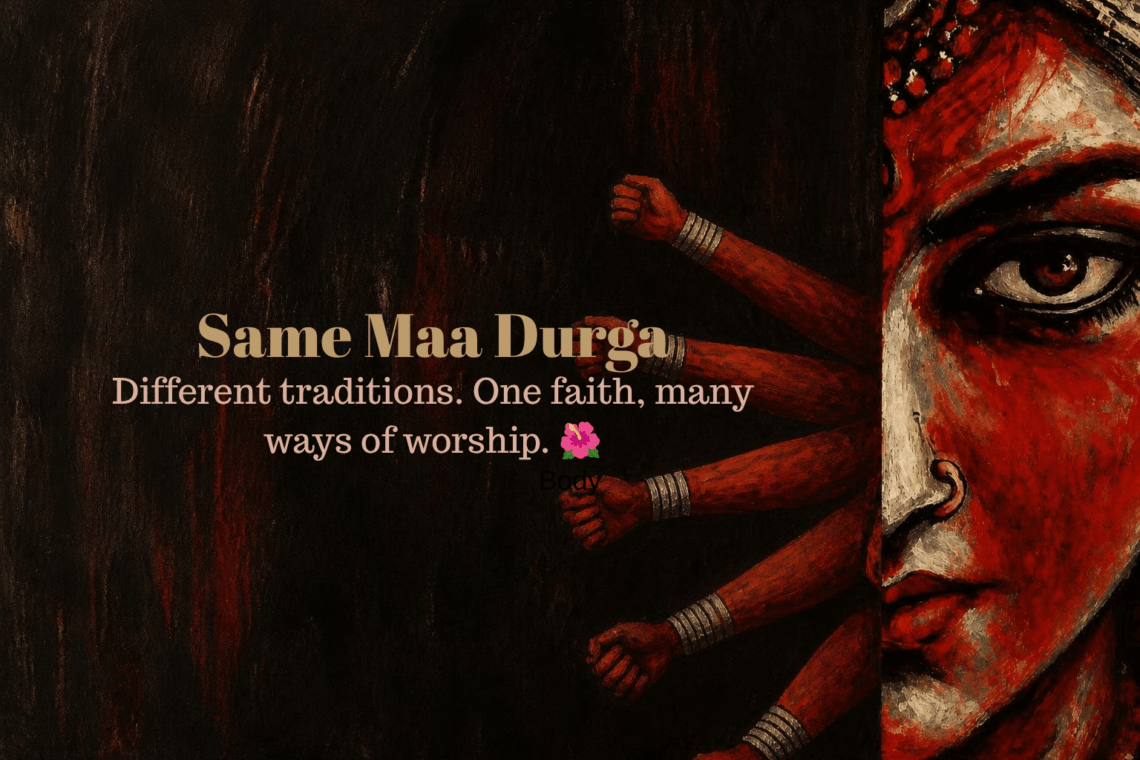
The interesting thing about this question is that Bengal and many other parts of India worship the same Goddess Durga, yet their rules around food during her festival can be completely different. In Bengal, eating fish and meat during Durga Puja can be entirely compatible with religious devotion, while many families in Maharashtra, Gujarat, Rajasthan and northern India avoid non-vegetarian food during Navratri.
The explanation is not simply that Bengalis follow different rules. It lies in the intersection of regional Shakta traditions, the history of Goddess worship, ritual ideas about purity, temple customs and the cultural significance of food.
To answer this properly, we need to distinguish what Hindu scriptures prescribe, what regional religious traditions practise, and what later family customs have established. These are related, but they are not the same thing.
1. The first important distinction: same Goddess, different ritual traditions
Hinduism does not have one universally followed dietary code for every festival, deity or region.
Durga is worshipped across India, but different communities have developed different ways of expressing devotion to her. Two particularly relevant traditions are:
- Shaktism (Shakta tradition): worship of the Goddess as the supreme divine power, with a range of ritual traditions, including some that historically involved animal sacrifice.
- Sattvic devotional traditions: an emphasis on restraint, purity, fasting and vegetarian food as a means of cultivating spiritual discipline.
These traditions are not mutually exclusive, and neither describes every Bengali or every Navratri-observing household.
A useful scholarly starting point is the research paper Foods Offered to Deities in Bengal: Tasting Ethnographic Flavours in the Gastronomic Offerings Prevalent in Bengali Culture, by Niladri Sekhar Dash, Mousumi Bhattacharjee and Shrotriya Dash. Published in December 2020, it examines Bengali Hindu food offerings through ethnography, culture and ritual practice. Read the research paper.
Its central relevance to your question is that food offered to a deity, food eaten during a ritual and food eaten as part of a festival are not necessarily governed by identical rules.
That distinction is essential to understanding Bengal.
2. Why some Bengalis eat fish and meat during Durga Puja


A. The influence of Shakta worship
In Shaktism, the Goddess is not merely a gentle mother figure. She can also be understood as the supreme power governing creation, destruction, protection and transformation.
Certain historical Shakta and Tantric traditions incorporated animal sacrifice, known as bali, into worship of particular forms of the Goddess. In some such traditions, the sacrificial animal’s meat could subsequently be consumed in a ritual context.
This history helps explain why meat is not automatically considered incompatible with every form of Goddess worship.
However, there are two important qualifications:
- Not every Shakta tradition permits or practises animal sacrifice.
- Eating meat at a family meal during Durga Puja does not mean that the meat was offered to the Goddess.
Many Bengali households and community pandals serve vegetarian bhog, while members of the same community may eat fish or meat separately at home.
NDTV Food’s cultural explanation of the practice discusses precisely this distinction between specific Shakta ritual offerings and ordinary festive meals.
B. Durga as a daughter returning to her parental home

There is also an important cultural difference in how the festival is emotionally experienced.
In Bengali tradition, Durga is closely associated with Uma, the daughter who visits her parental home from her husband’s home in Kailash. Her arrival is a homecoming, and her departure is marked by the sadness of bijoya.
This makes Durga Puja not only a period of worship but also a time of reunion, hospitality, elaborate meals and family celebration.
In that cultural setting, preparing a favourite meal or serving fish to guests can be part of the festive atmosphere rather than a rejection of religious discipline.
This interpretation is discussed in the cultural coverage of Bengali Durga Puja by NDTV Food and in reporting on Bengali food traditions.
C. Bengal’s relationship with fish
Geography and food history also matter. Bengal’s rivers, wetlands and long-established fishing traditions made freshwater fish a major part of regional cuisine.
Fish therefore carries a cultural meaning that is different from that of a special indulgence consumed only during festivals. For many Bengali families, it is everyday food as well as festive food.
The ethnographic paper by Dash and colleagues examines how regional food practices shape offerings to deities, including the place of fish in certain local religious traditions.
But we should not overstate the point: Bengal’s fish-eating culture helps explain the practice; it does not, by itself, establish a religious permission or obligation to eat fish during Puja.
3. Why many families in Maharashtra, Gujarat and northern India avoid non-vegetarian food during Navratri


The key difference is the religious emphasis placed on fasting, self-restraint and ritual purity.
For many devotees, Navratri is a period of vrata — a religious observance involving discipline, prayer and sometimes restrictions on food.
A sattvic diet is traditionally associated with qualities such as clarity, calmness and self-control. Within this framework, meat, fish and eggs are commonly excluded, and some devotees also avoid onion, garlic, grains and certain pulses.
The intention is not necessarily that meat is intrinsically sinful. Rather, avoiding particular foods becomes part of the discipline through which the devotee expresses reverence.
The important distinction is that this is a widespread devotional practice, not a single dietary command that every Hindu must follow whenever Durga is worshipped. Customs differ by sampradaya (religious tradition), region, family and the particular observance.
Likewise, people who worship Durga in Bengal may also fast, offer vegetarian bhog or follow dietary restrictions on particular days. Bengali Durga Puja is not uniformly non-vegetarian.
4. What do Hindu scriptures actually say?
This is where we need to be especially careful, because popular explanations sometimes claim that Hinduism either universally prohibits meat during Navratri or explicitly requires it during Bengali Durga Puja. Neither statement adequately represents the diversity of Hindu ritual traditions.
The Shakta scriptural tradition
Shakta religious literature includes ritual traditions in which animal sacrifice has a prescribed place under particular circumstances. The Devi Bhagavata Purana and various Tantric texts are relevant sources for studying Goddess worship and its ritual diversity.
A useful contemporary discussion of these traditions is published by Down To Earth in its article on Shaktism, Durga Puja and food practices in Bengal. It examines the relationship between Shakta religious traditions, scriptural interpretation and Bengali dietary customs.
Read: Why the Shakta tradition of Bengal differs on food choices.
However, the existence of scriptural or ritual precedents for sacrifice does not establish that every Bengali household may eat meat during every ritual, nor that animal sacrifice is compulsory.
The sattvic tradition
The Bhagavad Gita, particularly Chapter 17, verses 8–10, classifies food according to qualities associated with sattva, rajas and tamas. Verse 8 describes foods traditionally understood to promote vitality, health and well-being as dear to sattvic people.
This classification is often used in discussions of vegetarianism and devotional food. But it is important not to overstate the text: these verses do not explicitly prescribe a universal nine-day prohibition on meat during Navratri.
You can consult the text here: Bhagavad Gita, Chapter 17 — Bhagavad Gita As It Is.
The distinction is between a broader religious philosophy of food and a specific regional festival rule. The former can inform the latter without making every community’s practice identical.
5. What does the scholarly research tell us?
Here are the sources I would use to study this question seriously, distinguishing academic research from cultural journalism.
1. Dash, Bhattacharjee and Dash (2020)
Foods Offered to Deities in Bengal: Tasting Ethnographic Flavours in the Gastronomic Offerings Prevalent in Bengali Culture.
International Journal of Communication, 30(1–2), pp. 117–154.
This is the most directly relevant academic source found in this search. It uses Bengali literary material and cultural evidence to explore how food, religious offerings and community identity interact.
Source: Read the paper.
2. India Today (21 April 2024)
Why fish-meat on Bengali religious festivals? Historian Nrisingha Bhaduri explains.
This article provides a historian’s perspective on why Bengali food customs can differ from dietary practices elsewhere in India. It is useful for the relationship between regional cuisine, religious traditions and the ways communities relate to their deities.
Source: Read the interview.
3. Down To Earth (2026)
Why the Shakta tradition of Bengal differs on food choices from the rest of India.
This article is useful for exploring Shakta theology, ritual sacrifice and scriptural arguments surrounding food during Durga Puja. It is journalism discussing religious history, rather than a peer-reviewed theological study.
Source: Read the article.
One limitation worth stating: these sources support the cultural and historical explanation, but they do not establish a definitive, universally applicable scriptural ruling on what every Hindu should eat during Navratri. For that, one would need to examine the relevant ritual manuals, textual passages, commentaries and the specific sampradaya being discussed.
6. The comparison in one table
| Question | Bengali Durga Puja traditions | Navratri fasting traditions in many other regions |
|---|---|---|
| Main emphasis | Worship, homecoming, community celebration and regional customs | Worship, vrata, restraint and devotional discipline |
| Food at worship | Often vegetarian bhog; some specific traditions differ | Usually fasting-compatible or vegetarian offerings |
| Meat and fish | May be eaten in family meals; some specific rituals have their own rules | Commonly avoided by those observing dietary restrictions |
| Is the practice universal? | No | No |
| Is vegetarian food considered devotional? | Yes | Yes |
| Is non-vegetarian food automatically incompatible with worship? | Not across all Shakta traditions | Not a universal Hindu rule, though it conflicts with the observances of many devotees |
My conclusion
The most defensible answer is that the difference is largely a result of regional religious history and the particular meaning attached to the festival, rather than a difference in the Goddess being worshipped.
In many Bengali traditions, Durga Puja has developed through Shakta ritual practices, regional food culture and the emotional idea of Maa Durga returning to her parental home. In many other parts of India, Navratri is particularly associated with fasting, sattvic food and self-restraint.
Neither pattern describes every Hindu, and neither should be turned into a rule for all devotees.
A final distinction is especially important: eating non-vegetarian food during a festival and offering non-vegetarian food to the Goddess as part of a specific ritual are two different questions.
So when someone asks, “If we worship the same Durga, why do Bengalis eat fish and meat while we fast?”, the answer is that Hindu traditions have developed different ways of expressing devotion. The deity may be the same, while the ritual vocabulary, food customs and regional understanding of worship differ.