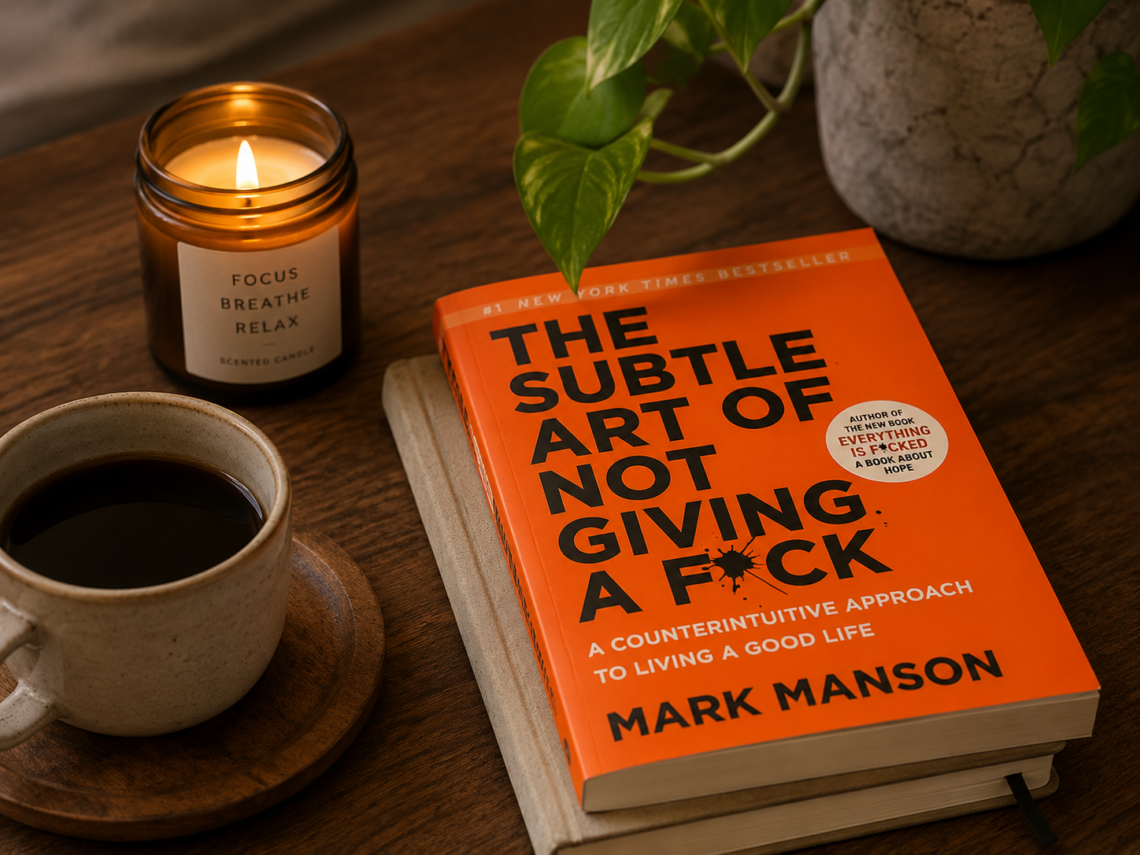
Mark Manson’s The Subtle Art of Not Giving a Fck* is less about caring less and more about caring wisely. Here are 10 lessons on happiness, failure, boundaries, values, responsibility and learning to focus our limited energy on what truly matters.
There are books we read for information, and then there are books that make us pause and question the way we have been living.
The Subtle Art of Not Giving a Fck* by Mark Manson belongs to the second kind.
Despite its provocative title, the book isn’t really about not caring. It is about caring more deliberately. We have limited time, energy and emotional space. So perhaps the real question isn’t “How do I stop caring?” but “What is actually worth caring about?”
That thought stayed with me.
Here are ten lessons from the book that I find particularly worth carrying into everyday life.
1. You don’t have to be positive all the time
We live in a culture that constantly tells us to look on the bright side.
Be grateful. Stay positive. Think happy thoughts. Everything happens for a reason.
But sometimes life simply hurts.
Manson’s reminder is liberating: we don’t have to turn every difficult experience into a motivational quote. Some things are painful, disappointing or unfair.
And perhaps acceptance is healthier than forced positivity.
You can acknowledge that something hurts without allowing it to define your entire life.
2. Choose what deserves your attention
We have a limited number of things we can genuinely care about.
Yet we spend enormous amounts of emotional energy worrying about other people’s opinions, social expectations, comparison, approval and things completely outside our control.
Not everything deserves a reaction.
Not every opinion needs an answer.
Not every disagreement needs to be won.
Not every person needs access to your peace.
Growing up, perhaps, is partly learning where to place your attention—and where to quietly take it back.
3. Happiness isn’t the absence of problems
This may be one of the most important lessons.
We often imagine that happiness will arrive when everything finally falls into place.
When the career is right.
When relationships are perfect.
When the children are settled.
When money is enough.
When life becomes predictable.
But life doesn’t work that way.
There will always be another problem.
The goal isn’t to create a problem-free life. It is to become better at choosing the problems that are worth having.
Because a meaningful life will inevitably come with difficulties.
4. Your values matter more than your achievements
It is easy to measure life through visible achievements.
How successful are you?
How much do you earn?
How many people admire you?
How impressive does your life look?
But external validation is an unstable foundation.
A quieter question might be more important:
What kind of person am I becoming?
Honesty. Kindness. Courage. Responsibility. Curiosity. Integrity.
These aren’t always Instagram-worthy achievements, but they create a life that feels meaningful from the inside.
5. You are responsible for your response
Life will hand us things we didn’t ask for.
Disappointments. Rejection. Loss. Failure. Other people’s choices.
We don’t always get to choose what happens.
But we do have some say in what we do next.
Responsibility doesn’t mean blaming ourselves for everything that happens.
It means recognising the part that belongs to us.
That distinction is powerful.
It wasn’t my fault and I can still decide what I do with it can both be true.
6. You are probably wrong about some things
This one is uncomfortable.
We like certainty.
We like believing that our opinions are correct, our memories are accurate and our interpretation of people and situations is the truth.
But we are human.
We misunderstand. We assume. We project. We change.
Being willing to say “I might be wrong” isn’t weakness.
It is intellectual humility.
And sometimes changing your mind is not losing an argument.
It is growing.
7. Failure isn’t the opposite of progress
We are taught to avoid failure as though it is evidence that something has gone terribly wrong.
But failure is often information.
It tells us what doesn’t work.
It exposes our assumptions.
It forces us to adjust.
It makes us less fragile.
Perhaps the real problem isn’t failing.
Perhaps it is building a life so carefully designed around avoiding failure that we stop taking meaningful risks.
8. Saying no is a form of self-respect
Every yes has a cost.
When you say yes to something, you are often saying no to something else—your time, energy, priorities, rest or relationships.
We sometimes say yes because we don’t want to disappoint people.
Because we want to be liked.
Because we feel guilty.
Because we fear being misunderstood.
But boundaries are not rejection.
A thoughtful no can protect the things that matter most.
You don’t need to explain every boundary until everyone agrees with it.
9. You are not as special as you think—and that’s freeing
This sounds harsh, but I found something strangely comforting in it.
We spend so much time worrying about how we are perceived.
What will people think?
Will they notice?
Will they remember?
Will they judge me?
The truth is that most people are busy living their own lives.
They are thinking about themselves, their problems, their insecurities and their next five things.
Realising that can be wonderfully liberating.
You don’t have to perform your life for an invisible audience.
You can simply live it.
10. Remember that life is finite
Perhaps the most profound lesson is also the simplest:
One day, this will all end.
Not in a morbid way.
In a clarifying way.
We don’t have unlimited time to chase approval, hold grudges, stay in situations that drain us or worry endlessly about things that won’t matter five years from now.
Mortality has a strange way of putting things into perspective.
It makes us ask:
What do I actually want to spend my limited time caring about?
Who do I want beside me?
What kind of life would feel meaningful to me?
What am I holding onto that I could finally let go?
The real art isn’t not giving a f*ck
Perhaps that is what I took away from the book most of all.
Not caring isn’t the goal.
Choosing what to care about is.
We cannot care deeply about everything.
We cannot fix everything.
We cannot please everyone.
We cannot control everyone’s perception of us.
And we certainly cannot avoid every difficult experience.
But we can become more selective about where we place our energy.
Maybe growing older is partly the process of reducing the noise.
Fewer explanations.
Fewer comparisons.
Fewer unnecessary battles.
Fewer attempts to be understood by everyone.
And more attention to the people, values, experiences and moments that genuinely matter.
The subtle art, then, isn’t learning to give fewer f*cks.
It is learning to give your precious few to the right things.
And perhaps that is where a quieter, more honest kind of freedom begins.
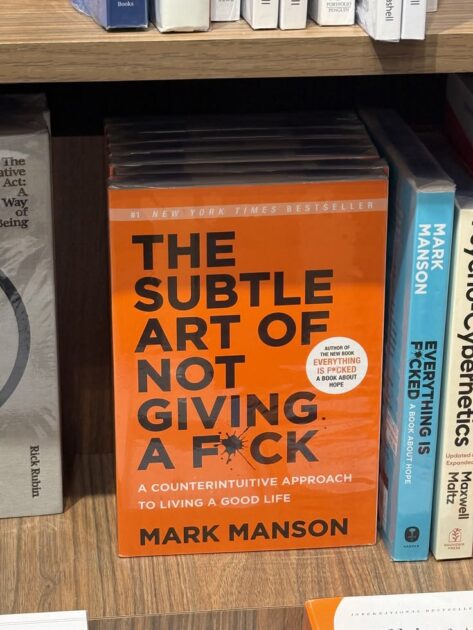
Here’s a link to the book The Subtle Art of Not Giving a F*ck: A Counterintuitive Approach to Living a Good Life on Amazon