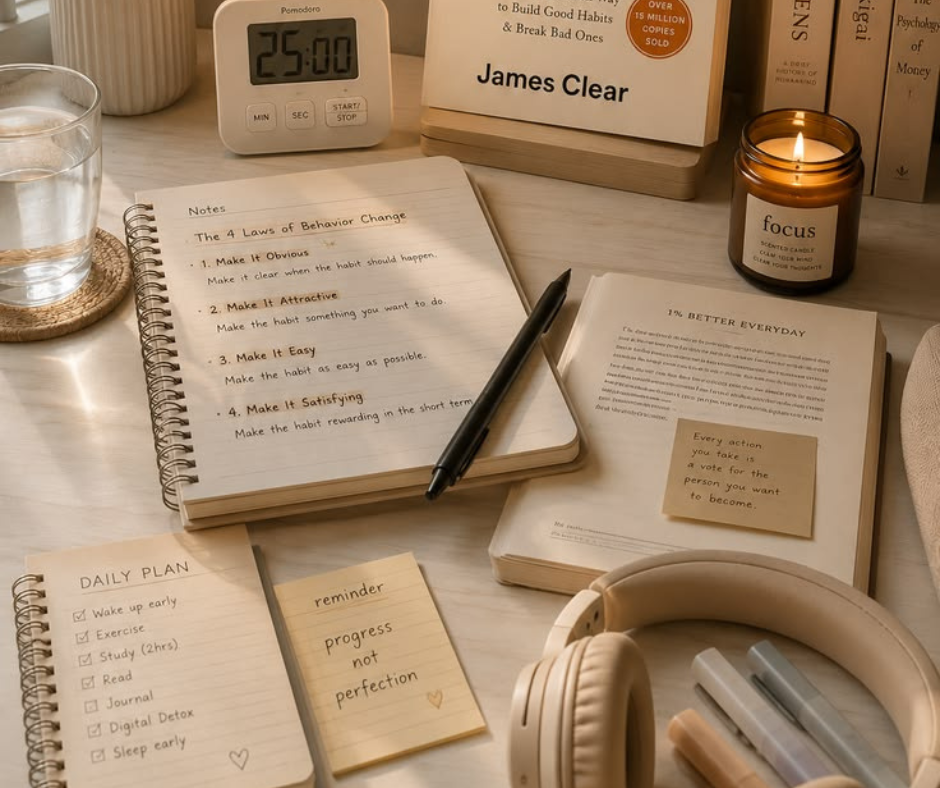
Atomic Habits by James Clear changed the way I think about self-improvement. Instead of trying to transform my entire life overnight, I learned to focus on small, consistent actions that compound over time. Here are 10 lessons from the book that stayed with me and genuinely changed how I approach everyday life.
There are books we read, underline, recommend to friends—and then quietly put back on the shelf.
And then there are books that make you look at your everyday life differently.
Atomic Habits by James Clear was one of those books for me.
I picked it up expecting another book about productivity, discipline and getting things done. Instead, it made me question something much more fundamental: What am I repeatedly doing every day, and who is that making me?
The central idea of the book is beautifully simple: small improvements, repeated consistently, can create remarkable change over time. Clear calls these small behaviours “atomic habits”—tiny actions that may seem insignificant in the moment but compound as they are repeated.
What stayed with me wasn’t just the science of habit formation. It was the way the book changed my relationship with progress.
I stopped waiting for dramatic transformations.
I started paying attention to the little things.
Related: Inner Glow Diaries: Small Habits, Big Energy Shifts
Here are the 10 lessons from Atomic Habits that I took into my own life—and that genuinely changed the way I live.
10 lessons from Atomic Habits
1. I stopped trying to change my entire life overnight
This was probably my biggest takeaway.
We often approach change with an all-or-nothing mindset.
Starting Monday, I’ll exercise every day.
I’ll wake up at 5 a.m.
I’ll stop eating sugar.
I’ll read 50 pages every night.
I’ll completely transform my life.
And then life happens.
We miss a day. Then another. And eventually the grand plan disappears.
Atomic Habits taught me to make the change smaller.
Instead of asking, “How can I completely transform myself?”, I started asking:
“What is one small thing I can do today?”
Ten minutes of walking is better than waiting for the perfect one-hour workout.
Reading five pages is better than waiting for an uninterrupted evening.
Writing a paragraph is better than waiting for inspiration to write an entire article.
Small doesn’t mean insignificant.
Small means sustainable.
2. I stopped obsessing over goals and started focusing on systems
Goals tell us where we want to go.
Systems determine what we actually do every day.
That distinction changed my thinking.
I used to think mostly in terms of outcomes: lose weight, write more, become healthier, be more productive, accomplish something specific.
Now I try to think about the routine behind the outcome.
If I want to read more, I need a reading routine.
If I want to write more, I need to make writing part of my day.
If I want to become healthier, I need everyday behaviours that support that identity.
The goal is the destination.
The system is the road.
And you can’t reach a destination by constantly staring at the map without walking.
3. I realised that my habits were shaping my identity
This was the lesson that went deeper than productivity.
Every repeated action is giving you evidence about the person you believe yourself to be.
If I write regularly, I start seeing myself as a writer.
If I exercise consistently, I begin seeing myself as someone who takes care of her body.
If I make time to read, I become someone who values learning.
This completely changed how I approached habits.
Instead of saying:
“I want to write a book.”
I can ask:
“What would a writer do today?”
Instead of:
“I want to become fit.”
I can ask:
“What would a person who takes care of her health do today?”
The difference may seem subtle, but it changes the conversation you have with yourself.
Clear describes this as identity-based habits: rather than focusing only on what you want to achieve, you begin with the person you want to become and use small actions to reinforce that identity.
4. I learned that consistency matters more than intensity
We tend to celebrate intensity.
The person who works out for two hours.
The person who reads an entire book in a weekend.
The person who suddenly decides to completely change their lifestyle.
But real life isn’t built on occasional bursts of motivation.
It is built on repetition.
Twenty minutes of movement done regularly can matter more than one exhausting workout followed by two weeks of inactivity.
A few pages every day can eventually become dozens of books.
A little writing every day can eventually become thousands of words.
Consistency makes ordinary actions extraordinary over time.
That idea has made me much kinder to myself.
I don’t need to do everything today.
I just need to keep showing up.
5. I stopped relying so much on motivation
This one was liberating.
We often think we need motivation before we begin.
But motivation is unreliable.
Some mornings you wake up inspired.
Some mornings you don’t.
Some days you feel energetic.
Some days you would rather stay in bed.
So instead of depending entirely on how I feel, I try to make the habit easier to start.
Keep the book where I can see it.
Make the workout clothes accessible.
Keep distractions away when I need to write.
Create a routine that reduces the number of decisions I have to make.
The book’s Four Laws of Behavior Change—make it obvious, attractive, easy and satisfying—gave me a practical way to think about this.
The less friction there is between me and the habit, the easier it becomes to repeat it.
6. I realised that my environment often matters more than willpower
This was another eye-opener.
We like to believe that discipline is everything.
But our surroundings constantly influence our behaviour.
If something is visible, convenient and easily accessible, we’re more likely to interact with it.
That made me look at my environment differently.
What do I see first thing in the morning?
What is within easy reach?
What distracts me when I’m trying to focus?
What makes healthy choices easier?
What makes unhealthy choices effortless?
Instead of constantly fighting myself, I can change the environment around me.
Sometimes the smartest form of discipline is removing the need for discipline.
7. I learned that missing once isn’t failure
This might be one of the most comforting lessons.
We often turn one bad day into a bad week.
Miss one workout:
“I’m falling off track.”
Eat something unhealthy:
“I’ve ruined my diet.”
Skip writing:
“I’ve lost my discipline.”
But one missed day doesn’t erase everything that came before it.
The important thing is returning.
Life will interrupt our routines. Travel, illness, work, family, celebrations, exhaustion—there will always be something.
The goal isn’t to never fall off track.
The goal is to become someone who knows how to come back.
That changed how I respond to setbacks.
I no longer see a missed day as the end of the habit.
I simply try to make the next day count.
8. I started appreciating the invisible phase of progress
One of the hardest things about changing is that progress isn’t always visible immediately.
You can exercise for weeks and not see a dramatic difference.
You can write for months before anyone notices.
You can read and learn quietly without having anything obvious to show for it.
It can feel as though nothing is happening.
But something is happening.
You are building the foundation.
That reminded me that lack of visible results doesn’t necessarily mean lack of progress.
Sometimes we’re simply in the part of the journey where the results are still accumulating beneath the surface.
The small actions are adding up even when we can’t see the total yet.
9. I stopped thinking of self-improvement as punishment
This may be my favourite shift.
Self-improvement can sometimes become another form of self-criticism.
I’m not fit enough.
I’m not productive enough.
I don’t read enough.
I should be doing more.
I need to be better.
But habits don’t have to come from dissatisfaction with who we are.
They can come from respect for who we want to become.
I can exercise because I want to take care of my body—not because I hate how it looks.
I can read because I enjoy learning—not because I think I’m not knowledgeable enough.
I can write because expressing myself matters to me—not because I need to prove something.
Growth feels very different when it comes from self-respect rather than self-rejection.
10. I finally understood that my life is being created in ordinary moments
Perhaps this is the biggest lesson I took from the book.
We tend to imagine that life changes during major moments.
A new year.
A new job.
A new relationship.
A major decision.
A dramatic transformation.
But most of life isn’t lived in those moments.
It is lived on ordinary Tuesdays.
In the morning routine.
In what we eat.
In what we read.
In what we think about.
In whether we go for that walk.
In whether we sit down and write.
In whether we choose to scroll for another hour or put the phone away.
In whether we keep a promise we made to ourselves.
Our lives are being shaped quietly, one ordinary choice at a time.
And that is what Atomic Habits made me see.
The real change wasn’t the habit. It was the way I looked at myself.
I didn’t finish Atomic Habits and suddenly become a perfectly disciplined person.
That’s not the point.
I still procrastinate.
I still have lazy days.
I still abandon routines sometimes.
I still have moments when I choose the easy option.
But I don’t see those things as proof that I can’t change anymore.
I understand that change isn’t about becoming a completely different person overnight.
It’s about making small choices that gradually become part of who you are.
One page.
One walk.
One healthy meal.
One paragraph.
One early morning.
One decision to put the phone down.
One promise kept.
And then another.
And another.
Perhaps that’s why the idea of getting 1% better resonates so deeply. The improvement doesn’t have to be dramatic to be meaningful. Clear’s entire approach is built around making small changes that can compound over time.
If you haven’t read Atomic Habits yet…
This might be your sign to pick it up.
If you’ve ever wondered why you struggle to stick to good intentions, why motivation disappears, or why you keep returning to habits you desperately want to change, this book is worth reading.
Don’t read it merely as a book about productivity.
Read it as a book about how your everyday choices shape the person you become.
And when you finish it, don’t try to change everything.
Pick one idea.
Make one small change.
Repeat it.
Then see where that tiny change takes you.
Because sometimes, the biggest changes in our lives begin with something so small that we almost don’t notice it happening.
If you haven’t read it yet, grab a copy of Atomic Habits by James Clear and start with one small habit. You can find the book through Amazon India. For more resources from James Clear, including the book and habit guides, visit James Clear’s official website.
Mark Manson’s The Subtle Art of Not Giving a Fck* is less about caring less and more about caring wisely. Here are 10 lessons on happiness, failure, boundaries, values, responsibility and learning to focus our limited energy on what truly matters. Read Here