“If you are constantly looking for ways to quiet the noise and figure out how to stop consuming content every second of the day, you aren’t alone—I recently realized my entire life has been hijacked by an algorithm, and I’m ready to fight for my silence.”
We wake up to the gentle, melodic strains of morning ragas, convincing ourselves we are setting a mindful, positive “vibe” for the day ahead. But before the music even finishes its first cycle, our thumb takes over. We are on Instagram, scrolling through an endless stream of updates, micro-trends, and lifestyle snippets before our eyes are even fully adjusted to the morning light.
From there, the engine of the day roars to life. I sit down at my desk, open my laptop, and craft thoughtful, reflective posts for other people to read and ponder. I write deep, introspective essays for my blog, pouring my energy into populating the internet with meaningful ideas. But have you ever stopped to look at what happens between those moments of creation?
Lately, I’ve been forced to look at my own daily routine, and the realization left me feeling a deep, quiet, and heavy exhaustion. My entire existence has become an unyielding, mechanized conveyor belt of consumption.
The Architecture of a Content-Addicted Day
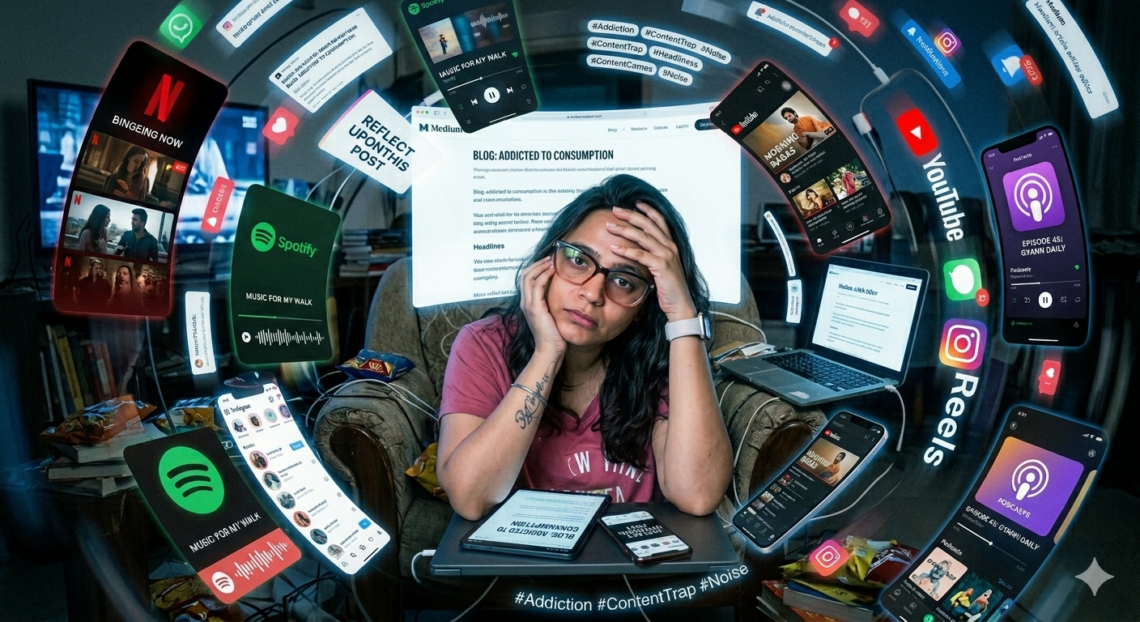
If I am completely honest with myself, my day is a masterclass in digital dependency. When I take an afternoon nap to recharge, I don’t just close my eyes; I plug in a podcast so a voice can lull me to sleep. When I lace up my shoes for a evening walk to get some fresh air, Spotify is already playing an energetic playlist in my ears. The moment I turn the ignition key in my car, the radio fills the cabin.
When evening arrives and the work is done, I “unwind” by binging a series on Netflix. If I find a piece of content that contains a shred of profound wisdom or sharp humor, I immediately forward it to my family chat group, passing the digital baton along. And finally, when the lights are out and my body is exhausted, I spend the final thirty minutes of my day mindlessly scrolling through Reels until my eyelids drop.
How much content do we actually consume? The terrifying answer isn’t measured in hours; it’s measured in transitions. We are consuming content during every single micro-gap of our lives.
[Wake Up] ➔ Ragas & Instagram Scroll
  ↓
[The Work] ➔ Writing & Creating Content
  ↓
[The Gaps] ➔ Podcasts (Napping) | Spotify (Walking) | Radio (Driving)
  ↓
[Wind Down] ➔ Netflix Binge ➔ Late-Night Reels Scroll ➔ Sleep
The Death of Background Processing
We have successfully automated away the “boring” parts of being human. Think about it: the five minutes you spend waiting for your tea to brew, the twenty minutes of a solitary commute, the quiet walk down the street to a local shop—these used to be empty spaces. Now, they are immediately plugged with audio, video, or text.
But those exact, unoccupied gaps are precisely where our original thoughts live.
Psychologists often talk about the brain’s “Default Mode Network” (DMN)—a network of interacting brain regions that activates when a person is not focused on the outside world. It is the system responsible for background processing. When you are doing “nothing,” your brain is actually hard at work: consolidating memories, sorting through complex emotions, making unexpected creative leaps, and updating your sense of self.
When we flood every single transition with external input, we deny our brains the permission to run this background processing. We aren’t giving ourselves a chance to process our own lives. We are so busy listening to what the world is saying that we have completely drowned out our own internal dialogue.
The Creator’s Paradox
As content creators and bloggers, we are constantly told that consumption is the fuel for creation. “Read widely, listen intently, watch everything,” the gurus say. But there is a distinct, dangerous tipping point where healthy consumption devolves into a numbing mechanism.
When we are trapped in a heavy sandwich of constant input, what we produce ceases to be authentic, original thought. Instead, it becomes a recycled, algorithmic synthesis of the last three podcasts we listened to or the last five reels we watched. We begin to think in trending audio and speak in internet captions.
I am sick and tired of being a passive consumer of life. I am tired of the low-grade anxiety that hums in the background whenever a room goes completely quiet. I want my original thoughts back. I want to know what my mind sounds like when it isn’t being guided by a playlist or a host’s voice.
Reclaiming the Micro-Gaps
Breaking this addiction doesn’t require a radical, dramatic digital detox where you throw your phone into a river and move to a cabin in the woods. That is neither sustainable nor realistic for those of us who build our livelihoods online. Instead, the revolution happens in the micro-gaps.
Moving forward, I am making a conscious, deliberate choice to leave a few windows of my day completely empty:
- The Silent Drive: The radio stays off. The car cabin remains quiet, allowing the mind to drift naturally with the road.
- The Raw Walk: No headphones, no Spotify. Just the ambient sounds of the neighborhood and the rhythm of my own footsteps.
- The Unplugged Transition: Sitting with a cup of tea or coffee without a screen in front of my face, simply watching the steam rise.
It is going to feel incredibly uncomfortable at first. The silence will feel loud, and the urge to reach into my pocket for a hit of dopamine will be powerful. But leaning into that discomfort is the only way back to myself. If we want to create things that truly cause people to reflect, we must first dare to sit in the quiet spaces where those reflections are born.
Let the silence back in. Your original thoughts are waiting for you there.
The Daily Edit: Why Japanese People Don’t Feel Lonely and Embrace Minimalist Living
The Reflective Zone: The Comfort of the Quiet: What Seven Days of Solitude Taught Me About the Noise We Hide In