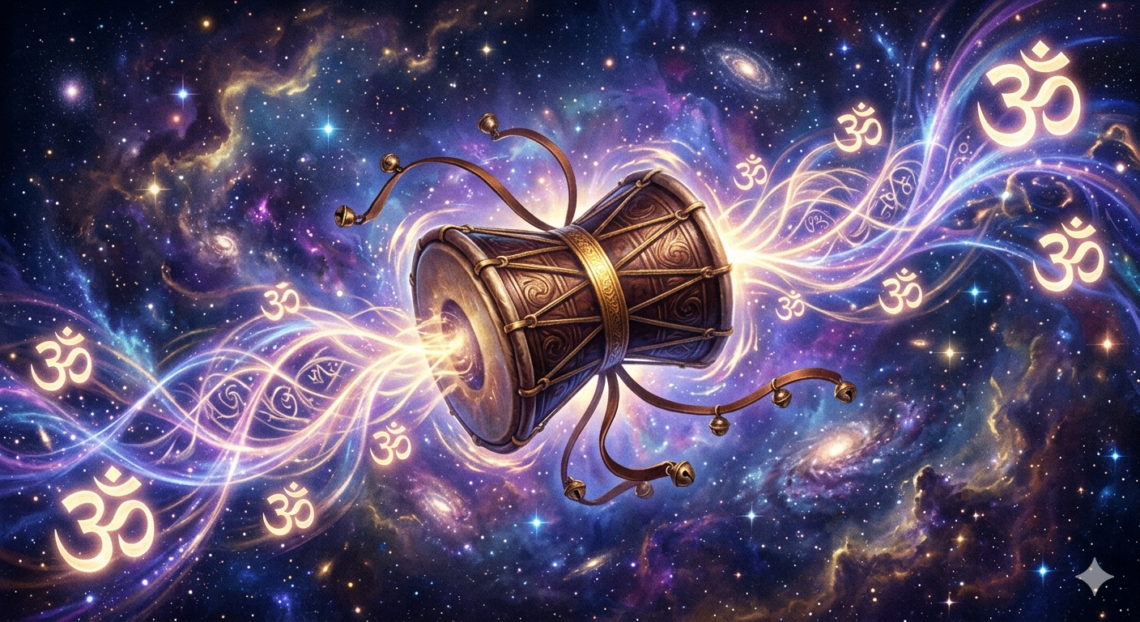
Have you ever wondered why Lord Shiva, the destroyer and transformer within the Hindu trinity, carries a small, hourglass-shaped drum? Shiva’s Damru represents the rhythm of creation, serving as a powerful spiritual reminder that the entire universe is alive with vibration, sound, and eternal cycles.
When Shiva performs his cosmic dance, the Tandava, the beats of his Damru echo through the cosmos. It is not just an ordinary instrument; it is the source of all existence, language, and cosmic order. Let us dive deep into the spiritual facts and uncover the profound meaning behind this sacred instrument.
1. The Shape of the Damru: The Convergence of Space and Time
To understand why Shiva’s Damru represents the rhythm of creation, we must first look at its unique hourglass structure.
The Damru consists of two triangular shapes meeting at a single, narrow point in the center. In spiritual symbolism, these two halves represent the dualities of our universe:
- The Upper Half: Represents the upward movement of creation, spirit, and consciousness.
- The Lower Half: Represents the downward movement into material manifestation, physical form, and earth.
- The Center Point: The narrow intersection represents the Bindu—the point of absolute unity where creation begins and where everything eventually dissolves.
When the drum is shaken, the two beads attached to its strings strike both sides alternately. This action symbolizes the passage of time, the balancing of opposites (like masculine and feminine energy), and the continuous loop of life, death, and rebirth.
2. Cosmic Vibration and Modern Physics
Long before modern science discovered that the universe is made up of vibrating energy strings, ancient rishis (sages) explained this truth through the imagery of Shiva.
[Silent, Unmanifest Universe] ➔ [Strike of the Damru] ➔ [Cosmic Vibration] ➔ [Physical Manifestation]
According to sacred Hindu texts, the universe was born from sound (Nada Brahma). When Shiva shakes the Damru, the vibrations create the primary energy required for matter to form.
Interestingly, quantum physics echoes this ancient wisdom. The String Theory suggests that the fundamental building blocks of our universe are not static particles, but tiny, vibrating strings of energy. Just as different vibrations on a guitar string create different notes, different cosmic vibrations create different elements of matter. The beats of Shiva’s Damru are nothing less than the poetic representation of these cosmic vibrations shaping reality.
3. The Birth of Language and the Shiva Sutras
The spiritual significance of the Damru extends deeply into sacred grammar and language. Legend has it that at the end of his cosmic dance, Lord Shiva played his Damru fourteen times.
From these fourteen distinct bursts of sound emerged the Shiva Sutras, also known as the Maheshvara Sutras. These sounds formed the foundational phonetics of the Sanskrit language. The great grammarian Panini used these exact sounds to write the structure of Sanskrit grammar, which is considered one of the most systematic language structures in human history.
Therefore, the Damru does not just symbolize the creation of stars and planets; it also represents the creation of speech, communication, knowledge, and human expression.
4. The Frequency of OM ($ॐ$)
When you listen closely to the steady, rhythmic beating of a Damru, the individual strikes eventually blend into a continuous, resonant hum. Spiritually, this underlying sound is Om ($ॐ$), the primordial syllable of the universe.
Key Spiritual Fact: The universe is never truly silent. It resonates with a cosmic background hum. The Damru acts as the cosmic broadcast tower, continuously sending out the vibration of Om to sustain life.
Without this rhythmic vibration, the universe would fall out of balance and collapse back into chaos. By keeping the rhythm alive, Shiva ensures that the cosmic order (Rita) is maintained day after day, eon after eon.
5. The Microcosm: How the Damru Lives Within You
The beauty of Vedic philosophy lies in its belief that whatever exists in the macrocosm (the universe) also exists in the microcosm (the individual). Shiva’s Damru represents the rhythm of creation inside your very own body.
The Heartbeat
Your heart beats in a constant, rhythmic pattern from the moment you are born until the moment you pass away. This internal rhythm is your personal Damru. It keeps your life force flowing, mirroring the cosmic rhythm of Shiva’s dance.
The Breath
The inhalation and exhalation of your breath represent the expanding and contracting nature of the Damru’s shape. When your mind is agitated, your rhythm breaks. When you meditate and center yourself, you tune your inner instrument to the peaceful frequency of Shiva.
Summary of the Damru’s Spiritual Facets
| Symbolism Element | Cosmic Meaning | Spiritual Impact on Humans |
| Hourglass Shape | Unity of Spirit and Matter | Balancing our physical and spiritual lives |
| The Center Point (Bindu) | The origin of the universe | The state of deep meditation and inner peace |
| Rhythmic Beats | Cosmic expansion and contraction | Our heartbeat and the natural cycle of breath |
| Fourteen Sounds | The birth of Sanskrit (Shiva Sutras) | The power of speech, mantras, and expression |
Conclusion: Tuning into the Cosmic Rhythm
Lord Shiva’s Damru is far more than a mystical prop in religious art. It is a profound metaphysical symbol showing us that life is not a series of random, chaotic events, but a beautifully orchestrated symphony.
By understanding that Shiva’s Damru represents the rhythm of creation, we can learn to embrace the natural ups and downs of our own lives. Just as the drumbeats go back and forth, our lives will experience moments of joy and moments of sorrow.
The ultimate spiritual lesson of the Damru is to remain centered at the Bindu—the quiet spot in the middle—while enjoying the magnificent, rhythmic dance of life all around us.
Featured Post: Daily Spiritual Cleansing Rituals for Stress Relief (Quick, Powerful & Easy to Follow)