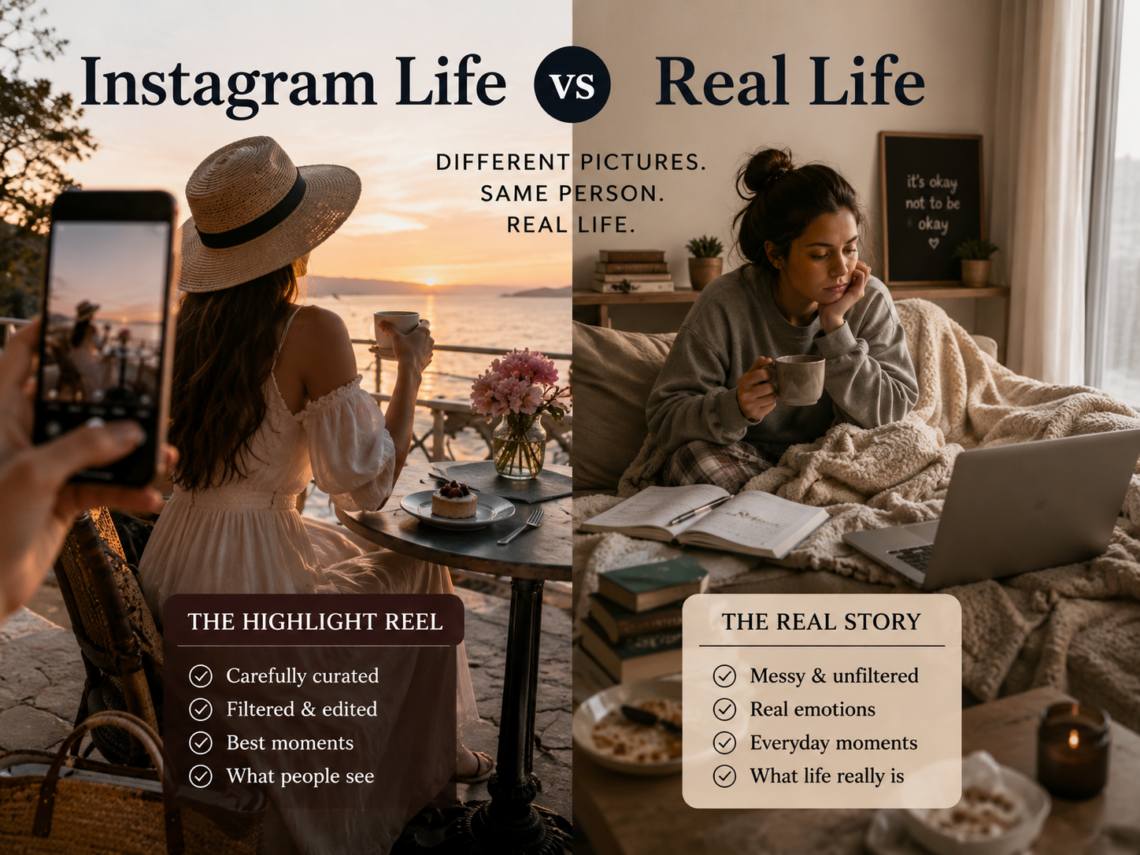
Instagram Life vs Real Life
We have become experts at documenting moments. A beautiful sunset is photographed before it is admired. A meal is carefully arranged before the first bite. Vacations become galleries. Relationships become announcements. Even ordinary mornings somehow look extraordinary once a filter is added.
This is the reality of modern life.
Instagram has given us a platform to preserve memories, discover creativity, build communities, and share our stories. There is nothing inherently wrong with that. The problem begins when the polished version of life slowly replaces life itself.
The difference between Instagram life vs real life is no longer just about edited photos. It is about the invisible pressure to appear happier, more successful, more attractive, and more fulfilled than we actually feel.
And somewhere between the perfect grid and the imperfect reality, many of us lose sight of ourselves.
Instagram Is a Highlight Reel, Not a Documentary
Every post tells a story—but not the whole story.
A smiling photograph may have been taken after an argument.
A travel picture doesn’t show the delayed flight, exhaustion, or anxiety.
A celebration doesn’t reveal months of disappointment that came before it.
Social media naturally encourages us to share our brightest moments because they are easier to celebrate and more likely to receive engagement. There is nothing dishonest about sharing joyful memories. The problem arises when we mistake everyone else’s highlights for their everyday reality.
Our minds rarely compare our best moments with someone else’s best moments.
Instead, we compare our ordinary Tuesday with someone else’s carefully selected highlight of the year.
It is an unfair comparison, yet we do it almost unconsciously.
The Curated Self vs The Authentic Self
Most people have different versions of themselves.
There is the professional self at work.
The relaxed self with close friends.
The responsible self around family.
The quiet self when alone.
Social media introduces another version—the curated self.
For many of us, especially on public platforms, there is an unspoken standard we feel expected to meet.
The caption must sound thoughtful.
The picture must be aesthetically pleasing.
The outfit should look intentional.
The vacation should appear meaningful.
The life should look interesting.
Ironically, many people admit they are far more authentic with a handful of close friends than with thousands of followers.
With trusted people, we can admit confusion, loneliness, insecurity, or failure.
Online, we often feel compelled to present confidence, certainty, and endless positivity.
The gap between these two selves can become emotionally exhausting.
The more energy we spend maintaining an image, the less energy remains for simply living.
When Scrolling Becomes Comparing
Comparison is one of the oldest human habits.
Social media has simply made it constant.
What begins as a few minutes of casual scrolling can quietly become an endless stream of comparisons.
Someone bought a new home.
Someone else launched a business.
Another friend is travelling abroad.
An influencer appears effortlessly fit.
A former classmate seems to have the perfect family.
Without realizing it, we begin measuring our own lives against hundreds of carefully curated snapshots every single day.
The danger isn’t inspiration.
Healthy inspiration motivates us.
Unhealthy comparison convinces us that everyone else is ahead while we are somehow falling behind.
The reality is that every person is fighting battles that rarely appear online.
No feed can fully capture grief, uncertainty, financial struggles, relationship conflicts, health concerns, or self-doubt.
Yet our minds often forget this.
The Blurring of Digital and Real Identity
As social media becomes part of our daily routine, something subtle happens.
The distinction between our digital identity and our real identity begins to blur.
Instead of asking:
“What do I genuinely enjoy?”
We begin asking:
“Would this make a good post?”
Instead of experiencing a moment, we evaluate its shareability.
Instead of dressing for comfort, we dress for photographs.
Instead of reflecting privately, we announce publicly.
Gradually, external validation starts replacing internal satisfaction.
Likes begin feeling like approval.
Comments become reassurance.
Silence starts feeling like rejection.
When our sense of worth depends on digital reactions, our emotional wellbeing becomes surprisingly fragile.
The Illusion of Perfection
Perfection has become one of social media’s most convincing illusions.
Filters smooth skin.
Editing apps reshape bodies.
Lighting changes appearances.
Angles transform ordinary spaces into luxury settings.
Artificial intelligence now generates images that barely resemble reality.
Even people who know these techniques exist can still feel inadequate when they compare themselves to edited content.
Influencers, celebrities, and even ordinary users unknowingly contribute to impossible standards of beauty, productivity, parenting, relationships, and success.
The consequence is not simply lower self-esteem.
It is the gradual belief that ordinary life is somehow insufficient.
But ordinary life is where real life happens.
Messy kitchens.
Unfinished conversations.
Bad hair days.
Unproductive afternoons.
Unexpected tears.
Simple dinners.
Quiet evenings.
These moments rarely trend online, yet they make up the majority of a meaningful life.
The Hidden Cost of Constant Validation
Human beings naturally appreciate appreciation.
Receiving kind words or encouragement feels good.
The problem begins when validation becomes a necessity instead of a bonus.
Social media platforms are intentionally designed to reward engagement.
Notifications trigger anticipation.
Likes create short-lived satisfaction.
Shares provide social approval.
Over time, our brains can begin associating self-worth with digital attention.
When a post performs well, we feel successful.
When it doesn’t, we question ourselves.
This emotional dependence can quietly affect mental health.
Research has linked excessive social media use with increased anxiety, lower self-esteem, sleep disturbances, loneliness, and depressive symptoms, particularly when use is driven by comparison rather than meaningful connection.
The issue isn’t social media itself.
It is the relationship we develop with it.
Confidence Is Built Offline
True confidence rarely comes from strangers on the internet.
It comes from private moments that no one else sees.
Keeping a promise to yourself.
Learning a new skill.
Being kind without recognition.
Recovering after failure.
Having difficult conversations.
Taking care of your body.
Reading instead of scrolling.
Walking in nature.
Choosing rest without guilt.
None of these moments may receive likes.
Yet they quietly strengthen who you are.
The strongest sense of identity develops when your opinion of yourself matters more than public opinion.
That kind of confidence cannot be filtered.
Real Life Is Beautiful Because It Is Imperfect
Real life contains contradictions.
You can be grateful and exhausted.
Successful and uncertain.
Loved and lonely.
Confident and still growing.
Life isn’t meant to look consistently beautiful.
It is meant to be genuinely experienced.
The pressure to maintain a perfect online image often disconnects us from the richness of ordinary existence.
The irony is that authenticity is what people truly connect with.
Not perfection.
Not flawless aesthetics.
Not carefully manufactured lifestyles.
People remember honesty.
They remember vulnerability.
They remember stories that make them feel less alone.
Choosing Presence Over Performance
Perhaps the healthiest way to use Instagram is not to abandon it, but to change our relationship with it.
Share because something is meaningful—not because it is impressive.
Capture memories—but don’t let the camera replace the experience.
Celebrate achievements—but leave room for struggles too.
Use social media as a tool—not as a measure of your worth.
Your life does not become more valuable because it receives more attention.
Some of the most meaningful moments will never be photographed.
Some of the deepest conversations will never become captions.
Some of your greatest personal growth will happen quietly, without applause.
And perhaps that is exactly how it should be.
Because when the phone is put away, the filters disappear, and the screen goes dark, the only life that truly matters is the one you are actually living.
So the next time you find yourself comparing your real life to someone else’s Instagram life, remember this:
Perfection online is an illusion.
Peace offline is real.
And your authentic life will always be more valuable than your curated one.
Suggested Posts: