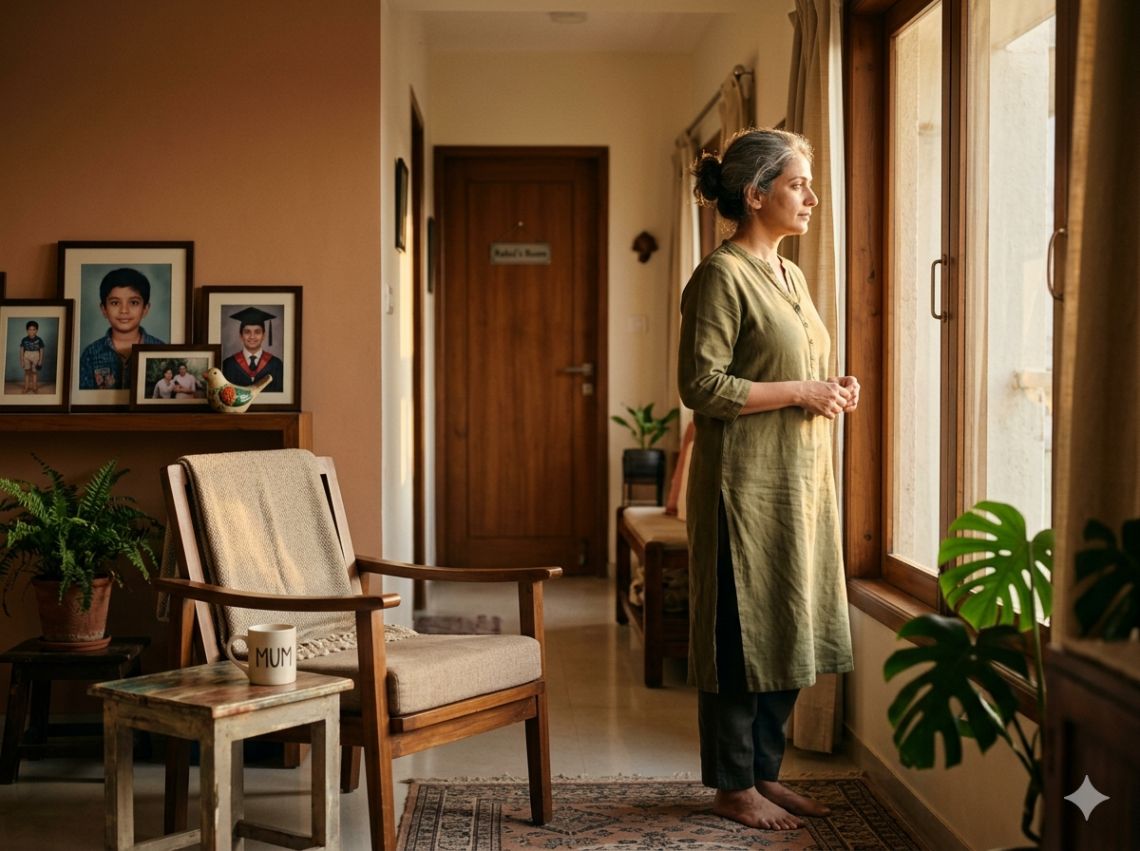
Changing parent-child relationships quietly teach us that love does not disappear with distance — it simply learns new ways to stay present.
There is a moment many parents are never fully prepared for.
The room stays clean for days. The dining table becomes quieter. The phone no longer rings every hour with small questions that once felt exhausting but now feel precious. Your child has not stopped loving you — they have simply stepped into a life of their own.
And yet, somewhere deep within, a parent wonders:
Why do I miss them so much when they seem completely happy without me?
This question lives silently in countless homes. It is not born from selfishness. It comes from the emotional shift that happens when parenthood changes shape. For years, parenting is active, demanding, consuming, and deeply intertwined with identity. Then gradually, without warning, it becomes quieter, observational, and emotionally distant in ways no one really teaches us to navigate.
The changing parent-child relationship is one of the most profound emotional transitions of adulthood.
The Parent-Child Bond Is Built Differently
A child enters a parent’s life and changes it permanently.
From the first cry to the first day of school, from illnesses to celebrations, parents spend years emotionally organizing their world around their children. Daily routines, decisions, finances, dreams, and even personal sacrifices slowly begin revolving around the family unit.
Parenthood is not merely a role. It becomes an emotional ecosystem.
Children, however, are naturally designed to move outward.
As they grow, their psychological task is different from that of parents. Their purpose is to discover identity, independence, friendships, ambition, love, freedom, and eventually a life beyond home. Healthy adulthood often requires emotional separation.
This is where the emotional imbalance begins.
Parents are holding memories.
Children are building futures.
Neither is wrong.
Why Parents Feel the Absence More Deeply
Many parents feel guilty admitting how deeply they miss their children after they move away, get married, or become busy with work and relationships.
But grief around changing family dynamics is normal.
Parents do not only miss the physical presence of their children. They miss:
- being needed,
- being included in daily life,
- familiar routines,
- shared meals,
- noise and chaos,
- spontaneous conversations,
- and the version of themselves that existed during active parenting years.
When children leave home, parents are often forced into an unexpected self-reflection:
Who am I outside of caregiving?
This emotional transition can feel lonely because society celebrates children becoming independent, but rarely discusses the emotional adjustment parents experience afterward.
Children Love Differently As They Grow
One of the hardest truths parents encounter is realizing that adult children may not express attachment the same way anymore.
As children mature, emotional priorities shift naturally:
- careers demand attention,
- relationships deepen,
- social lives expand,
- responsibilities increase,
- and personal independence becomes fulfilling.
This does not always mean emotional neglect.
Often, adult children feel secure enough in parental love that they do not constantly verbalize it. They carry the relationship differently — sometimes quietly, internally, or intermittently.
Parents, however, continue carrying years of emotional memory simultaneously.
A mother may still remember:
- the child who held her hand crossing the road,
- the teenager waiting after school,
- and the adult now living independently.
To parents, all versions exist at once.
That is why separation can feel emotionally layered.
The Emotional Growth Parents Rarely Talk About
One of the most overlooked aspects of parenting is that children are not the only ones growing. Parents evolve too.
In the early years, parenting is about protection and control.
Later, it becomes about trust and release.
This transition requires emotional maturity.
Many parents unconsciously attach their self-worth to being constantly needed. So, when children become self-sufficient, an emotional void appears. The silence can feel personal even when it is not.
But this stage also offers something meaningful:
an opportunity for rediscovery.
Parents often spend decades prioritizing everyone else. Once children build independent lives, parents finally confront questions they postponed for years:
- What brings me joy now?
- What identity exists beyond motherhood or fatherhood?
- What relationships need nurturing?
- What dreams did I leave unfinished?
- What does emotional independence look like for me?
This phase, though painful initially, can become deeply transformative.
Healthy Parent-Child Relationships Must Evolve
One reason emotional distance feels painful is because many families unconsciously expect relationships to remain emotionally identical forever.
But healthy relationships evolve.
A parent-child relationship that was once built on dependence must eventually transform into one built on mutual respect, emotional freedom, and adult companionship.
This shift is difficult because it requires parents to slowly release control while children learn to maintain connection voluntarily rather than out of obligation.
The healthiest families are not the ones where children never leave emotionally.
They are the ones where love remains steady despite changing forms.
Sometimes connection becomes:
- fewer phone calls but deeper conversations,
- less physical presence but greater respect,
- less dependency but more genuine affection.
Love matures too.
The Loneliness Parents Often Hide
Many parents quietly struggle with emotional loneliness after children move away.
Especially in cultures where family closeness defines identity, empty spaces inside homes can feel emotionally overwhelming. Social media also intensifies this experience. Parents may see their children laughing with friends, traveling, building careers, or creating new lives while feeling excluded from those experiences.
This can unintentionally create resentment, guilt, or emotional expectations.
But emotional awareness becomes important here.
Children are not abandoning parents by becoming independent. They are fulfilling the very purpose parenting prepared them for.
The success of parenting was never permanent dependence.
It was raising emotionally capable human beings.
And yet, acknowledging this truth does not erase longing.
Parents are still human.
Learning to Love Without Holding Too Tightly
Perhaps one of the deepest forms of love is learning to remain emotionally available without emotionally gripping too tightly.
Children need space not because they love less, but because adulthood demands expansion.
Parents, too, deserve expansion.
This stage of life can become an invitation toward:
- self-care,
- friendships,
- personal healing,
- creativity,
- spiritual growth,
- travel,
- purpose,
- and emotional renewal.
The empty nest is not only an ending.
It can also become a beginning.
Final Thoughts
Parent-child relationships are not meant to stay frozen in one emotional form forever.
There will be phases of closeness, distance, dependence, independence, silence, reconnection, and rediscovery. What remains constant underneath all of it is invisible emotional imprint.
Children may not always express missing their parents in obvious ways. But love does not disappear simply because life becomes fuller.
And parents eventually learn that loving deeply sometimes means allowing space gracefully.
Maybe growing older as a parent is not about learning how to hold on.
Maybe it is about learning how to let love evolve without believing it has disappeared.