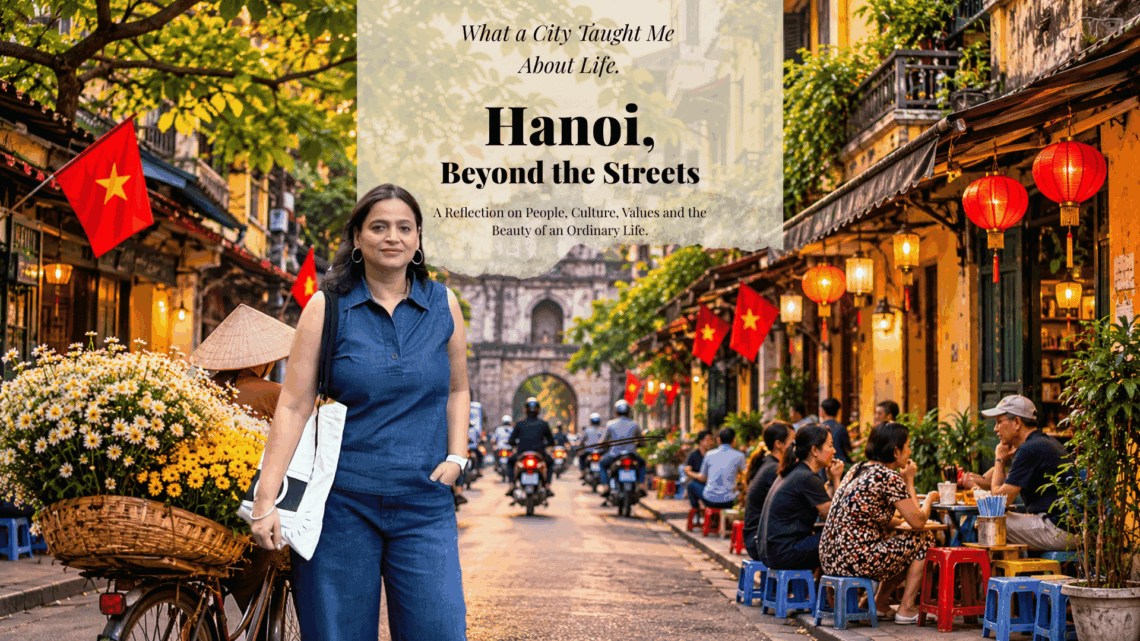
Life and culture in Hanoi reveal themselves in the most ordinary moments — a street vendor setting up for the day, families sharing meals, incense burning in a small altar, and people quietly going about their lives. As an Indian traveller, I found a certain familiarity in its chaos, traditions and community, but also a different way of looking at simplicity, resilience, respect and the beauty of everyday living.
Hanoi, especially the Old Quarter, is one of those places that I think an Indian traveller can connect with beyond just its architecture, food, or tourist attractions. It has a certain energy that feels familiar to India, yet it is distinctly Vietnamese.
What makes Hanoi interesting is the coexistence of chaos and calm, tradition and modernity, ambition and simplicity. You see it in the streets, in the way people work, in how families live, and in how the city continues to hold on to its cultural identity.
1. The Old Quarter — a city that lives on the streets
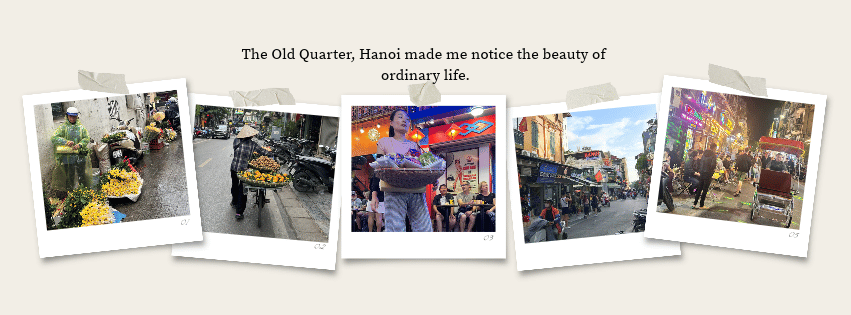
The Old Quarter is not a place that is merely visited. It feels like a place that is being lived in, right in front of you.
The narrow streets, tiny shops, scooters weaving through impossibly small gaps, vendors sitting on little stools, people eating breakfast on sidewalks, families running businesses from their homes — life spills onto the streets.
There is very little separation between living, working, eating, socialising and resting. A shop may be a business at the front and someone’s home behind it or upstairs. A street corner may become a dining room. A tiny pavement may become a gathering place.
Coming from India, this can feel surprisingly familiar. We too understand cities where life isn’t neatly contained within buildings. Where the street itself becomes an extension of the home and where people aren’t afraid of occupying public space.
But Hanoi has its own rhythm. Despite the apparent madness of traffic, there is a strange flow to it. People seem to negotiate space instinctively. There is movement everywhere, yet life doesn’t seem to stop to complain about the movement.
It’s almost as if the city has accepted that life will never be perfectly orderly — and has learnt to live beautifully within that disorder.
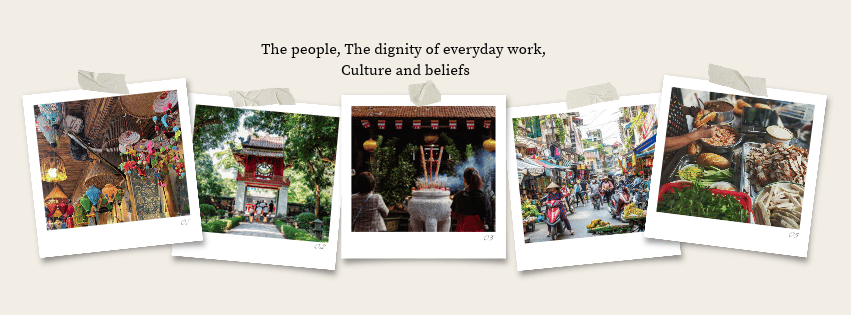
2. The people — a quiet dignity in everyday life
One of the things I find beautiful about Vietnamese culture is the importance placed on dignity in ordinary life.
There is something about the way people go about their daily routines — the street vendor setting up her stall, the elderly person sitting outside a shop, someone preparing a bowl of noodles, a family quietly having breakfast together — that makes you notice how life doesn’t always need to be grand to be meaningful.
Traditional Hanoi culture has placed considerable value on respect for elders, modesty, family responsibility, politeness and restraint in how one conducts oneself. Historical ideals of being well-mannered, educated, articulate and not unnecessarily boastful have shaped the city’s cultural identity. Hanoi Culture and Sport Facilities
From an Indian perspective, some of this may feel familiar. We too come from a culture where family, elders, rituals and social responsibility have deep roots.
But what I personally think a visitor can appreciate is this:
- People don’t have to be loud to be noticed.
- There is beauty in being unassuming.
- You can be hardworking without making a performance of it.
- Ordinary life deserves respect too.
- There is a certain charm in people who simply get on with life.
Of course, Hanoi is a modern city, and people are as diverse in personality, ambition, lifestyle and outlook as anywhere else. These are cultural impressions, not traits that every individual will have.
3. Their beliefs — the past is still part of the present
This is one of the most fascinating aspects of Vietnamese culture.
Vietnamese spirituality is not always neatly divided into one religion. Buddhism, Confucian values, Taoist influences, local folk beliefs and ancestor veneration can coexist in a person’s life.
A person may not describe themselves as particularly religious, yet still light incense for their ancestors, visit a pagoda, make offerings during important days, or pray for their family.
Ancestor remembrance is particularly meaningful. There is an underlying belief that the family connection doesn’t end when someone dies. The deceased remain part of the family’s story, deserving remembrance, respect and gratitude. Families honour them through incense, offerings, death anniversaries and gatherings. Pew Research Center+1
As an Indian, you might find a deeply familiar feeling here. We also light lamps, offer prayers, remember ancestors, seek blessings, and see family as something that extends beyond the living.
But what is interesting to observe in Hanoi is how these beliefs often appear woven into the everyday. Spirituality isn’t necessarily something that requires a grand occasion. It can exist quietly in the home, in a small altar, in a temple tucked between shops, in the incense smoke rising above an otherwise ordinary street.
It makes you think about how a culture preserves a sense of continuity — how people carry their past with them while still moving forward.
4. The work ethic — resilience without spectacle
Hanoi is a city of small businesses, family enterprises, street vendors, shopkeepers, craftsmen, food stalls and people who seem to have been doing the same thing for years.
The Old Quarter was historically organised around craft and trade streets. Different trades clustered together, with families and artisans carrying forward their livelihoods and skills across generations. Even today, some of those street names and commercial identities preserve that history. Vietnam Tourism+1
As a visitor, you begin to appreciate a certain kind of resilience. Not the motivational, Instagram-worthy kind of resilience. The everyday kind.
Wake up. Open your shop. Prepare food. Make a living. Take care of your family. Do what needs to be done.
There is something humbling about watching people work without romanticising their lives. You don’t know their struggles, their dreams, their financial pressures or what they have endured. But you see them participating in life, and it reminds you that the world is held together by millions of ordinary people doing their jobs.
I think there is something beautiful about that.
5. Community and family — life is not always individualistic
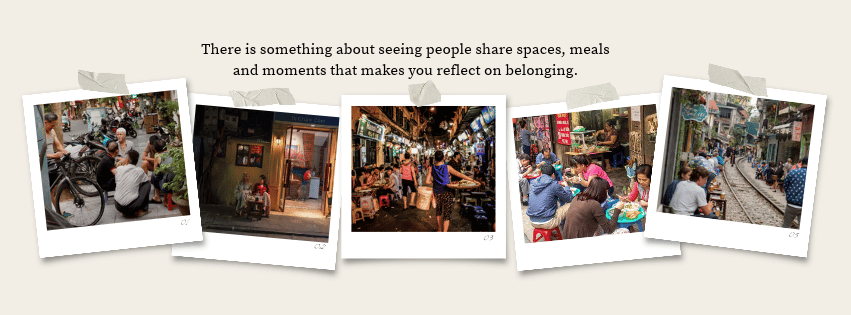
Vietnamese culture has traditionally placed importance on family bonds, collective responsibility and intergenerational relationships. Family meals, remembering ancestors, celebrating Tet (Lunar New Year), and maintaining relationships with relatives are important ways these connections are sustained. Hanoi Culture and Sport Facilities
Walking through Hanoi, you notice people sitting together. Eating together. Talking. Sharing a little space. Sometimes several generations seem to be part of the same everyday scene.
It can make you reflect on how much of modern life has become centred around the individual — our own ambitions, our own schedules, our own screens, our own personal space.
And yet, there is something comforting about seeing life unfold collectively.
Not that community is always easy. It can bring obligations, expectations and restrictions, too. But belonging to something larger than yourself can also bring a sense of rootedness that is increasingly difficult to find in modern cities.
6. What an Indian traveller can learn from Hanoi
I think there are some lovely things we can take away from a city like Hanoi without assuming their way of life is better than ours.
| What you notice | What it makes you reflect on |
|---|---|
| People living simply in small spaces | How little we sometimes need to feel content |
| A culture of respecting elders | The importance of patience and learning from generations before us |
| Ancestor remembrance | Our connection to those who came before us |
| Small family businesses | The dignity of honest, everyday work |
| Street life and shared spaces | Human connection doesn’t always need planning |
| People going about ordinary routines | Life doesn’t need to be extraordinary to be meaningful |
| A city preserving old traditions | Progress doesn’t have to mean erasing your roots |
And perhaps the biggest thing is not to judge a culture by how much it resembles our own, but to observe what it has managed to preserve that we may have slowly lost, overlooked or stopped valuing.
7. The feeling Hanoi leaves you with
What I find most interesting about Hanoi is that it doesn’t seem to be trying to impress you all the time.
It isn’t a city that needs to be polished for you to find beauty in it. The beauty is in the unpolished bits — the old man having coffee, the woman selling fruit from her bicycle, the tiny plastic stools, the incense burning in a corner, the shop opening for another day, the sound of life happening without an invitation.
As someone coming from India, perhaps you can recognise the familiarity of chaos, warmth and community, but also observe a different cultural temperament — the quietness, the restraint, the deeply rooted traditions and the way people seem to find their place within the everyday rhythm of the city.
And maybe travelling to a place like Hanoi teaches you something that travel is supposed to teach us:
You don’t always need to come back with a new adventure, a spectacular view or a checklist of places visited.
Sometimes you come back with a new appreciation for how other people live, what they value, how they find meaning, and how differently — yet beautifully — a human life can be lived.
That, to me, is the real beauty of travelling.
Related: Vietnam, One Cup at a Time: Discovering the Story Behind Its Coffee Culture
Vietnam in 10 Days: Hanoi, Phu Quoc & Ho Chi Minh City – A Journey of Culture, Coffee and Contrasts